
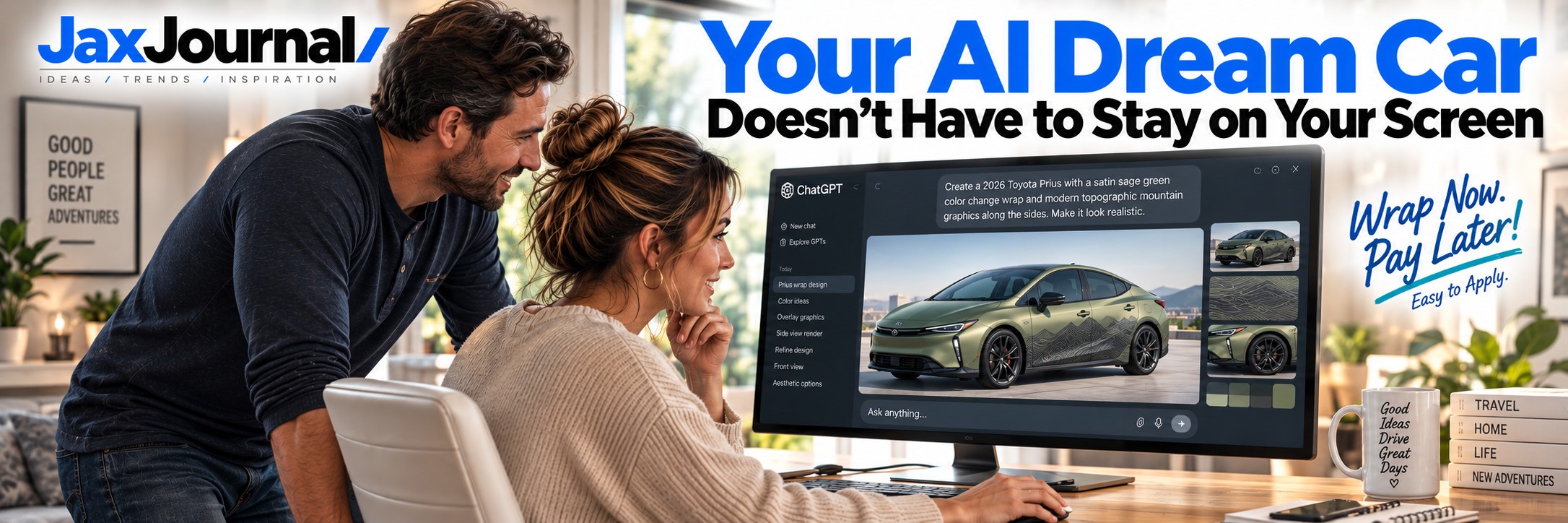
You Created It. You Love It. Now, How Do We Turn It Into a Real Vehicle?Something pretty remarkable has happened over the last couple of years. People who have never considered themselves…
You Created It. You Love It. Now, How Do We Turn It Into a Real Vehicle?
Something pretty remarkable has happened over the last couple of years. People who have never considered themselves designers are suddenly designing cars. Not engineering them or necessarily drawing them in the traditional sense, but designing what they want them to look like and exploring ideas that, until very recently, probably would have remained entirely in their imagination.
Someone can take a photograph of their otherwise ordinary black SUV, upload it to an AI platform and begin experimenting. Maybe they ask to see it in a satin metallic green, then add bronze wheels and a stripe before deciding the green should be darker and the stripe should look like something inspired by a 1970s European race car. Twenty minutes later, they're staring at an image on their screen thinking, I want my car to look exactly like that.
And that's where things get interesting, because for the first time, millions of people have access to creative tools that allow them to visualize ideas without necessarily having the technical ability to draw or digitally create them themselves. The question is no longer whether you can visualize your dream car. The question is whether that image can actually be turned into something you can drive.
More often than you might think, the answer is yes.
You Don't Have to Be a Designer Anymore to Have a Great Idea
This may be the biggest change AI has brought to the vehicle wrap industry. Before generative AI, explaining a visual idea could be frustrating, particularly if you knew exactly what you wanted something to feel like but didn't have the vocabulary or design skills to communicate it.
You might tell a designer you wanted something "kind of vintage, but modern," or that you were looking for a particular shade of blue that reminded you of the ocean just before sunset. Maybe you had five photographs saved from completely different cars and liked one thing about each of them. An experienced designer could certainly work with those references, but there was still a translation taking place between the picture in your head and the picture in theirs.
AI has fundamentally changed that conversation because now you can begin experimenting yourself. You can try outrageous ideas without worrying whether they'll work, change colors in seconds, ask to see a completely different direction and then immediately decide you liked the first version better. You can continue refining the concept until you arrive at something that feels like you.
That's not replacing creativity; it's unlocking it, and perhaps the most important benefit is that it gives you something tangible to bring to a professional wrap designer. Instead of sitting across the desk trying to explain an image that exists only in your head, you can put something on the screen and say, "This. I want something like this."
That's a fantastic place to start.
But There's an Important Word in That Sentence: Start
This is where we need to separate an AI rendering from an actual vehicle wrap design, because the two aren't necessarily the same thing.
An AI image is generally trying to create a convincing visual representation on your phone, tablet or computer screen. It isn't necessarily working from the precise dimensions of your vehicle, nor is it thinking about how much additional material an installer might need around a particular panel, where one printed section will overlap another or how a graphic will continue around a compound curve.
It may not even have created the vehicle itself correctly. Look closely at enough AI-generated cars and you'll eventually discover a five-spoke wheel with six spokes, a door handle that mysteriously disappears, a taillight that doesn't exist or a body line that changes halfway down the side of the vehicle. AI can also create graphics that flow beautifully from the hood onto the fender from one particular viewing angle but would be extremely difficult, or sometimes physically impossible, to align that way on the actual vehicle.
Then there is the issue of resolution. Something that looks spectacular on a 15-inch laptop screen may not contain enough usable image information to reproduce cleanly when part of that image needs to become several feet wide.
None of those things mean your idea won't work. They simply mean we've reached the point where the professional part of the process begins.
Think of Your AI Design as a Concept Car
Automobile manufacturers have been doing something similar for decades. They create a concept car for an auto show that is exaggerated, dramatic and sometimes completely impractical, and then engineers begin figuring out how much of that original idea can survive contact with reality.
The production version may need different mirrors, different wheels, a little more ground clearance and, presumably, actual windshield wipers. The challenge is making those necessary changes without losing whatever it was about the concept that made people fall in love with it in the first place.
That's essentially what happens when you bring us an AI-generated wrap concept.
Our objective isn't necessarily to reproduce every pixel contained in the image, because in some cases that wouldn't even be possible. Our first job is to understand what you love about it. Maybe it's the color combination, the pattern, the way a graphic moves across the side of the vehicle or simply the overall personality the image conveys.
Once we understand what made you look at that rendering and say, "That's the one," we can begin translating the idea from an image into something designed specifically for your actual vehicle.
Now We Have to Introduce Your Dream to Your Actual Car
This is the part of the process customers rarely see. A professional wrap isn't designed on a generic rectangle and then stretched over a vehicle. Your car has doors, handles, mirrors, bumpers, sensors, wheel openings, body lines, trim, windows, spoilers, compound curves and plenty of other places where a graphic can look fantastic on a computer screen but considerably less successful once somebody opens a door.
Critical design elements therefore have to be positioned intelligently. If there's a face in the artwork, we probably don't want a door handle coming out of its forehead. If there's lettering, we don't want half of a word disappearing into a wheel opening, and if an important graphic crosses multiple body panels, we need to think about how those individual pieces will actually align during installation.
Most importantly, if you drive a particular year, make and model of vehicle, we need to design for that vehicle, not for something AI generated that happens to look similar to it.
This is one of the reasons the human designer hasn't disappeared from the process. In many ways, their role has simply changed. AI can help establish the destination; an experienced wrap designer figures out how we're actually going to get there.
Some Things Will Need to Be Recreated
Let's say your AI rendering includes an incredible abstract pattern running down the side of the car and it's one of the main reasons you love the design. Unfortunately, the only version of that pattern exists inside a relatively small, flattened image.
We may need to recreate it.
The same can be true of logos, lettering and other important design elements. AI has become remarkably good at generating imagery, but professional large-format production requires us to think about resolution, scalability, color accuracy and editability in ways that simply aren't important when an image is being viewed on a screen.
Large-format graphics can be particularly unforgiving because something that looks perfectly sharp at three inches wide can become pretty disappointing when we enlarge it to three feet. Important elements may therefore need to be rebuilt, redrawn or otherwise recreated on a properly scaled vehicle template before the final production files are prepared.
That's an important expectation to establish from the beginning: you're not necessarily giving us the file we're going to print. You're giving us the idea we're going to recreate.
There's a big difference, and that's where professional design and production experience become so important.
This Is Also Where Materials Enter the Conversation
AI doesn't have to worry about whether the color it created actually exists in vinyl, whether that particular finish can conform around a bumper or whether a material is appropriate for the application. We do.
If your concept is essentially a solid color change, we can look through the enormous selection of films available from quality manufacturers and determine whether an existing color and finish gets us where you want to go. With hundreds of colors, metallics, glosses, satins, mattes and specialty finishes available, there's a very good chance we can get surprisingly close.
But suppose you've created something completely unique—a gradient from deep blue into violet with a subtle metallic texture and a graphic element running through it. At that point, we may be talking about creating a digitally printed custom wrap rather than selecting an existing solid-color film.
Or perhaps you love the color transformation you've created but you're equally concerned about protecting the original paint underneath. Now the conversation may move toward colored Paint Protection Film, which can combine a significant visual transformation with the protective characteristics associated with PPF.
There isn't one material that's right for every idea, and part of turning an AI rendering into reality is determining which physical product gives us the best way to achieve the effect you're looking for.
Your AI Image Doesn't Have to Be Perfect
This is worth emphasizing because it's very easy to disappear down the AI rabbit hole trying to perfect every tiny detail before showing your concept to someone.
Please don't spend three weeks trying to make your AI rendering technically perfect before showing it to a wrap professional. If the wheel looks a little strange, we don't care. If a reflection in the door doesn't make sense, that's okay, and if you couldn't get AI to spell something correctly, you're certainly not the first person to experience that.
What we really need is enough information to understand your vision, and sometimes several images are actually more useful than one. Maybe you love the color from one rendering, the stripe from another and the overall feel of a third. Show us all three, because those images can help us understand the common thread running through what you're trying to create.
The purpose of these images isn't necessarily to serve as production artwork. Think of them instead as a visual conversation between you and the people who will ultimately turn your idea into something real.
And that's something AI is extraordinarily good at helping create.
There May Be Things We Tell You We Can't Do
This is part of the process too, and a responsible wrap company shouldn't simply say yes to everything that appears in an AI-generated image.
There may be an effect that doesn't translate particularly well into print, a graphic positioned somewhere that can't realistically be installed or an extremely intricate design that looks amazing from one computer-generated camera angle but begins to fall apart when we try to continue it around the rear of the vehicle.
In those situations, we may recommend moving something, simplifying part of the artwork, changing the scale, using a different material or recreating an effect in a slightly different way. Those recommendations aren't about changing your idea for the sake of changing it. They're about protecting the idea and making sure the real vehicle you eventually pick up looks every bit as exciting as the image that made you want to pursue the project in the first place.
Then Something Really Cool Happens
Eventually, the project stops being an AI image and starts becoming a real vehicle wrap.
The concept becomes artwork, the artwork is adapted to the actual dimensions and body lines of the vehicle, and the files are prepared for large-format production. Depending on the project, the graphics are then printed, finished, trimmed, organized and prepared for installation before an installer begins applying those pieces to the actual car.
And this is the part of the process I find genuinely fascinating.
An idea that may have started with you sitting on your couch typing a few sentences into ChatGPT, Gemini, Grok, Midjourney or another creative platform has now become something you can walk around, touch, drive, park in your garage and watch other people turn their heads to look at.
The idea isn't trapped on your screen anymore.
It's sitting in your driveway.
This Is Really What WrapJax.ai Was Built For
WrapJax.ai exists because we started seeing a widening gap between what people can now imagine and what they know how to produce.
AI has put remarkably powerful creative tools into the hands of everyday vehicle owners, and we think that's exciting. We don't believe the answer is to look at a customer's AI rendering and say, "That's not a real wrap design." We'd much rather look at it and say, "That's a great idea. Let's figure out how to build it."
You can create your concept using whichever AI platform you prefer. Experiment with it, change your mind a dozen times, make it subtle or make it completely ridiculous. Ask the AI to show you something you've never seen on another car and continue refining the idea until you finally create an image that makes you stop scrolling and stare at it for a minute.
When that happens, save it.
That's the image we want to see.
Upload it to WrapJax.ai and let an experienced wrap professional take a look at what you've created. Maybe the concept translates almost perfectly. Maybe we need to make some changes, or perhaps your rendering sends us in a direction neither of us would have considered otherwise.
That's part of the fun, because AI hasn't eliminated the human side of designing a vehicle. If anything, it has allowed a lot more humans to participate in the creative process.
And your dream car?
It doesn't have to stay on your screen.