A Little Extra Value from WrapJax - $50 & $100 OFF. Absolutely FREE!
Read More
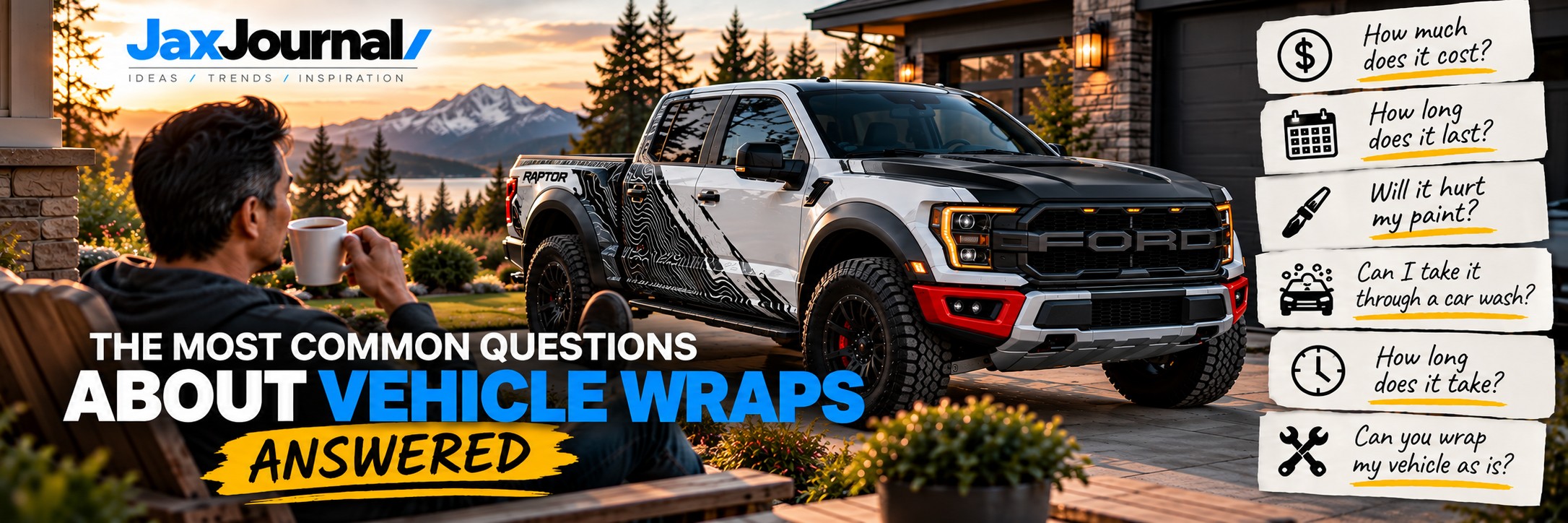
What Google and AI tell you is a good place to start. Here’s what you should know before actually wrapping your vehicle.
If you're thinking about wrapping a vehicle, chances are you've already asked Google, ChatGPT or another AI platform at least a few questions.
How much does a vehicle wrap cost? How long does it last? Will it hurt my paint? Can I take it through a car wash?
These are some of the most commonly searched questions about vehicle wraps, and for the most part, the answers you'll find online aren't necessarily wrong.
They're just often incomplete.
At WrapJax, we've been wrapping vehicles since 2008, and one thing nearly two decades in the industry has taught us is that there is rarely a universal answer that applies to every vehicle, every material and every customer.
So rather than simply repeating the answers you can already find online, we thought we'd add some real-world context from the other side of the squeegee.
1. How much does a vehicle wrap cost?
This is easily one of the most common questions—and also one of the hardest to answer with a national average.
You'll commonly see full vehicle wrap prices quoted online anywhere from approximately $2,000 to $7,500 or more.
That's an enormous range for a reason.
The cost of a wrap can depend on the vehicle's size, body style and complexity, the material selected, how much disassembly is required, the condition of the vehicle, whether graphics need to be designed and whether you're purchasing a commercial wrap, a solid-color change or something considerably more customized.
Even two vehicles of similar size can require very different amounts of labor.
A relatively straightforward sedan, for example, may be much easier to wrap than a vehicle with complicated bumpers, spoilers, vents, sensors, textured plastics and highly sculpted body panels.
Partial wraps are another option. You don't necessarily have to wrap an entire vehicle to make a dramatic visual change—or create an effective commercial advertising vehicle.
That's why at WrapJax we generally recommend getting an actual quote based on the specific vehicle and what you're trying to accomplish rather than relying too heavily on a national average.
2. How long does a vehicle wrap last?
You've probably seen answers ranging from three to five years, with some sources suggesting as long as seven years.
That's possible, but there is more to the story.
The useful life of a wrap depends on the material, installation, climate, vehicle use, storage conditions, maintenance and even where the vinyl is located on the vehicle.
A vertical door panel doesn't necessarily age at the same rate as a hood, roof or trunk lid receiving direct sunlight every day.
A vehicle parked indoors much of its life may also experience dramatically different aging than a vehicle parked outside year-round.
And longer isn't always better.
One of the biggest mistakes we've seen over the years is an owner leaving aging vinyl on a vehicle indefinitely simply because it hasn't started falling off yet. As some films age, removal can become substantially more difficult and expensive.
Think of a wrap as a replaceable exterior finish with a service life—not a permanent coating.
Ask your wrap provider what material is being used, what its expected service life is for your application and when they recommend removing or replacing it.
3. How long does it take to wrap a vehicle?
For many vehicles, you should plan on approximately several business days, rather than expecting a same-day installation.
Why?
Because installing the vinyl is only part of the process.
A professional installation can involve washing and preparing the vehicle, removing contaminants, inspecting the paint, removing certain trim or components when appropriate, installing the material, trimming and finishing edges, post-heating critical areas and performing a final inspection.
Commercial graphics may also involve design, proofing, revisions, printing and production before the vehicle ever arrives.
Some vehicles are relatively straightforward. Others aren't.
A complicated installation involving extensive disassembly, difficult body contours, custom graphics or multiple types of material can take considerably longer.
At WrapJax, we'd much rather determine how much time a particular vehicle actually needs than try to make every vehicle conform to the same production schedule.
The better question isn't necessarily "How fast can you wrap it?" It's "How much time does this particular vehicle require to do it correctly?"
4. Can you wrap a vehicle with scratches, dents or rust?
This is one area where many online answers are too absolute.
You'll often see:
"No. A damaged vehicle cannot be wrapped."
That's not entirely accurate.
A vehicle can sometimes be wrapped with minor scratches, small dents and other imperfections. The important question is whether the surface is stable, properly bonded and suitable for vinyl adhesion.
Vinyl is extremely thin. It isn't body filler.
If you can see or feel a significant defect before the wrap is installed, there is a good chance you'll still see it afterward.
Rust, peeling clear coat, failing paint, loose body filler and poorly repaired surfaces present a much bigger concern because the vinyl is adhering to whatever is underneath it.
If that surface fails, the wrap can fail with it.
This is why vehicle inspection is such an important part of the WrapJax process. Sometimes what matters most isn't the vinyl going onto the vehicle—it's understanding what's underneath it first.
5. Will a vehicle wrap damage my paint?
On healthy, properly cured OEM paint, quality wrapping films are specifically engineered to be removable.
But there's an important phrase in that sentence:
Healthy OEM paint.
Aftermarket paint, previous collision repairs, poorly prepared panels, failing clear coat, rust and unknown bodywork can change the equation considerably.
When vinyl is removed, it places stress on the surface beneath it. Factory finishes in good condition generally tolerate that process very well when proper materials and removal techniques are used.
A poorly bonded repaint may not.
This is one reason WrapJax asks customers about previous paint and body repairs before wrapping a vehicle. Knowing the history of the vehicle can help identify potential concerns before installation begins.
And while vinyl can provide a degree of protection against UV exposure, environmental contamination and light surface abrasion, a standard vinyl wrap should not be confused with Paint Protection Film (PPF).
If your primary objective is protecting paint against rock chips and road debris, PPF is the product specifically engineered for that job.
6. Can you wrap over Paint Protection Film?
Often, yes. In fact, PPF and vinyl can sometimes be used together when a customer wants both personalization and additional protection.
But the condition, age, type and placement of the existing PPF matter.
There can also be important considerations when removing vinyl installed over PPF later.
Because WrapJax installs both vinyl wraps and Paint Protection Film, we often encourage customers interested in combining the two to think about them as one overall exterior strategy rather than two unrelated products.
If you're planning to combine them, discuss the complete installation strategy with your shop before either material is installed.
7. Can windows be wrapped?
Yes—but not with ordinary opaque wrap vinyl if visibility through that window is required.
Commercial vehicle graphics commonly use perforated window film, sometimes called window perf. Tiny holes in the material allow occupants to see outward while the printed graphic remains visible from outside the vehicle.
There are limitations.
Visibility can be reduced, particularly at night or in poor weather, and local laws and vehicle safety requirements can affect which windows may be covered.
Rear-window visibility, cameras, sensors, wipers and defrosters should also be considered before deciding where window graphics make sense.
8. How should I wash a wrapped vehicle?
Generally, the gentler the better. Hand washing with a wrap-compatible automotive cleaner and soft wash media is typically the preferred method.
Automatic car washes—particularly those using aggressive rotating brushes—can be hard on exposed edges, seams and specialty finishes.
Pressure washing isn't automatically prohibited either, but pressure, temperature, nozzle selection, distance and the angle at which water hits an edge can all matter.
Matte, satin, textured, chrome and other specialty materials can have their own care requirements.
Most importantly, don't assume the same waxes, compounds, polishes and chemicals you used on painted surfaces are appropriate for vinyl.
At WrapJax, we consider aftercare part of the wrap—not something that begins after the job is over. Ask your installer for care instructions specific to the material installed on your vehicle.
9. Can ceramic coating be applied to a vehicle wrap?
In many cases, yes. Ceramic coatings designed for vinyl and PPF can make routine cleaning easier, reduce the tendency of contaminants to bond to the surface and help maintain the appearance of the material.
But product compatibility matters.
Gloss, satin, matte and textured films can react differently to coatings, which is another reason to use products specifically intended for the surface being treated.
WrapJax offers ceramic coating alongside vinyl and PPF because these products can complement one another when they're selected and applied correctly.
Ceramic coating doesn't make a wrap indestructible, but it can be a useful part of a broader maintenance strategy.
10. Can I remove a vehicle wrap myself?
Technically? Yes.
Should everyone do it? Probably not.
Wrap removal is affected by the film's age, adhesive, temperature, exposure history and condition of the paint underneath.
Professional installers use heat and controlled removal techniques to reduce adhesive residue and minimize unnecessary stress on the painted surface.
Older films can be considerably more challenging. Material may break into small pieces rather than releasing in large sections, and excessive heat or poor technique can create additional problems.
Removal should also be approached cautiously when the vehicle has aftermarket paint or previous body repairs.
It's also worth asking about removal before choosing an installer. At WrapJax, we think the eventual removal of a wrap should be considered part of the life cycle of the product from the beginning.
11. Does a vehicle wrap hide bad paint?
Not really. This is one of the biggest misconceptions about wraps. Vinyl follows the surface underneath it remarkably closely.
Deep scratches, rock chips, dents, peeling clear coat and bodywork imperfections can remain visible after installation—and sometimes become even more noticeable under certain colors and finishes.
A wrap can completely transform the color of a vehicle.
It doesn't magically transform the condition of the surface underneath it.
12. Do you have to remove door handles, mirrors, lights and trim?
Sometimes. Professional installers don't necessarily disassemble every vehicle the same way.
The goal is to remove enough components to produce a clean, durable installation without unnecessarily dismantling the vehicle.
Door handles, mirrors, emblems, lights, trim pieces, spoilers and other components may be removed depending on the vehicle and the areas being wrapped.
Experienced installers determine where disassembly provides a meaningful installation advantage and where it creates unnecessary risk.
That's a judgment that comes largely from experience. After wrapping vehicles since 2008, we've learned there isn't much value in removing something simply for the sake of saying it was removed.
More disassembly isn't automatically evidence of a better wrap.
13. Can a leased vehicle be wrapped?
Often, yes—but check your lease agreement first.
One of the attractions of vinyl is that it is removable, making it popular with people who want to personalize a vehicle without permanently changing its original color.
The same concept can be useful for businesses operating leased fleet vehicles.
However, lease agreements vary, and customers should verify their requirements regarding vehicle modifications and the condition in which the vehicle must be returned.
If removal will eventually be required, plan for it from the beginning rather than waiting until the day before the vehicle is due back.
14. Is a color-change wrap different from a commercial vehicle wrap?
Very much so. A color-change wrap is primarily about changing the vehicle's appearance.
A commercial wrap has another job entirely:
It has to communicate.
That means design, readability, logo placement, viewing distance, vehicle contours, doors, handles, windows and even how the vehicle looks while moving all become part of the process.
A beautiful graphic isn't automatically an effective commercial wrap.
This is an important distinction at WrapJax because we work with both personal vehicles and commercial fleets. The materials and installation techniques may overlap, but the objectives can be completely different.
The best commercial vehicle graphics are designed around the vehicle rather than simply placing a rectangular advertisement onto it.
15. Can AI help me design my vehicle wrap?
Absolutely—and this is becoming one of the most interesting changes in our industry.
Tools such as ChatGPT and other generative AI platforms make it possible for someone with no professional design experience to begin exploring colors, themes, patterns and complete vehicle concepts.
You can upload photographs of your actual vehicle, reference images, logos and other creative assets and begin visualizing possibilities before entering the formal design process.
We've embraced this at WrapJax as well. Through WrapJax.ai, customers can use AI as part of the inspiration and concept-development process and bring those ideas into a real-world wrap environment.
But there is an important distinction:
An AI rendering is a concept—not necessarily an installation-ready wrap design.
AI doesn't automatically understand exact vehicle dimensions, panel seams, door handles, body contours, production bleeds, print resolution or how graphics need to align from one panel to another.
Think of AI as an extraordinarily powerful visualization and brainstorming tool.
Then let an experienced wrap designer turn the idea into something that can actually be produced and installed.
One Question Google Can't Answer: Who Should Wrap My Vehicle?
Search engines and AI can tell you a lot about vehicle wraps.
They can't inspect your paint.
They can't feel a questionable surface.
They can't determine whether that bumper was repainted five years ago.
And they can't tell you whether the person installing your wrap has the experience to recognize a potential problem before thousands of dollars of material and labor go onto your vehicle.
Before selecting a wrap company, ask about the materials they use, warranties, installation experience, paint inspection, removal, aftercare and what happens if you have a problem after the installation.
Ask to see their work.
Better yet, visit the facility.
That's something we actively encourage at WrapJax. See where your vehicle will be worked on. Look at projects in progress. Ask questions. Look at materials and finishes in person. A good wrap shop shouldn't need to hide the process from you.
A vehicle wrap is part material, part design, part production and a very large part craftsmanship.
And whether you ultimately work with WrapJax or another qualified professional, knowing what questions to ask puts you in a much better position to understand what you're actually buying.
Do Your Research. Ask Questions. Then Have Some Fun With It.
Whether you're changing the color of your personal vehicle, protecting a new car with PPF or turning a fleet into mobile advertising, educating yourself before the project begins can make the entire experience better.
And don't be afraid to bring ideas—even crazy ones.
Save images you like. Take pictures of your vehicle. Experiment with AI. Explore colors and materials. Ask questions.
If you want to take those ideas a step further, that's exactly the kind of bridge we're building with WrapJax.ai—a place to start with an idea, explore what's possible and then determine how that concept can translate to an actual vehicle.
That's part of what makes wrapping a vehicle fun.
Because the question isn't simply, "Can my vehicle be wrapped?"
More often than not, the much more interesting question is:
What could it become?
Promote. Personalize. Protect.
Was this article helpful?