A Little Extra Value from WrapJax - $50 & $100 OFF. Absolutely FREE!
Read More
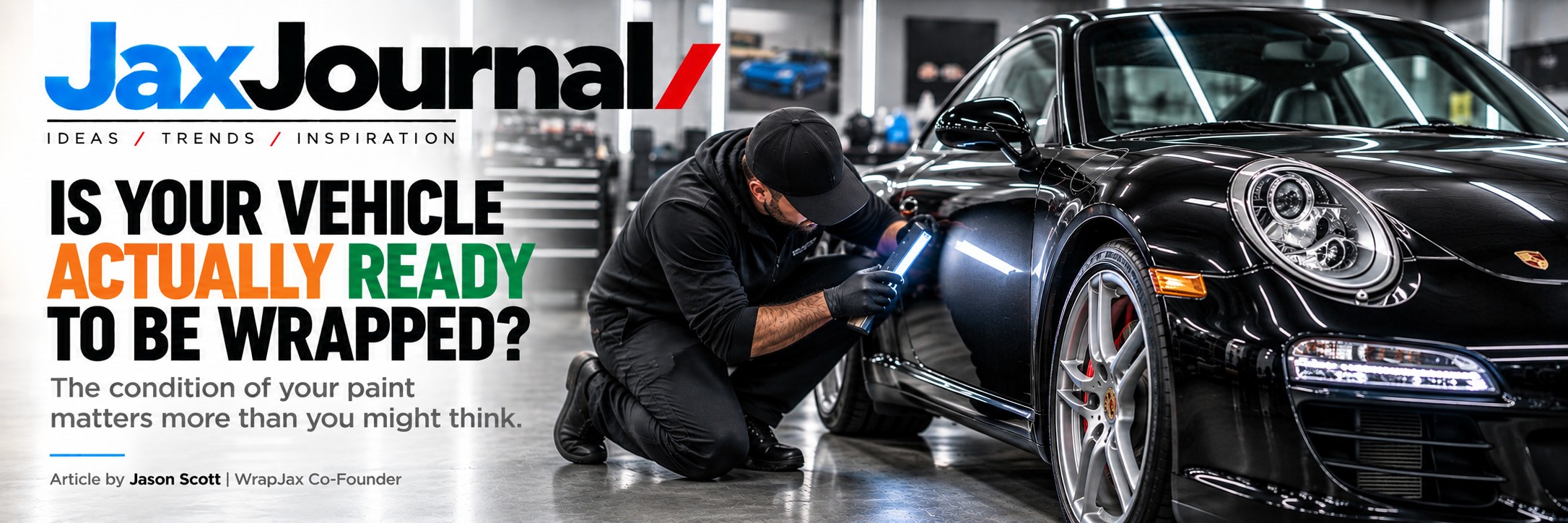
A great wrap starts long before the first piece of vinyl goes on the vehicle. When most people think about getting a vehicle wrapped, they naturally focus on the fun part: the color,…
A great wrap starts long before the first piece of vinyl goes on the vehicle.
When most people think about getting a vehicle wrapped, they naturally focus on the fun part: the color, the design, the finish and what the vehicle is going to look like when it’s done.
But there’s another conversation that should happen first.
What are we sticking it to?
A vehicle wrap is ultimately an adhesive product, and even the best wrap material in the world can only perform as well as the surface underneath it allows. That makes the condition of the vehicle—and particularly its paint—an important part of determining whether a vehicle is truly ready to be wrapped.
It’s a conversation we have regularly at WrapJax.
With a newer, factory-finished vehicle, there are generally fewer concerns. With an older vehicle, a previously repaired vehicle or one with deteriorating paint, corrosion or aftermarket bodywork, there can be considerably more to discuss.
And those conversations are much better to have before installation begins.
Vinyl Doesn't Fix What's Underneath It
One of the biggest misconceptions about vehicle wraps is that vinyl can simply cover damaged paint and make the problem disappear.
Visually? Sometimes.
Technically? Not necessarily.
Peeling clearcoat, flaking paint, rust, corrosion, poorly adhered primer, exposed body filler and other unstable surfaces can prevent wrap material from bonding properly. Even if the material initially sticks, the underlying surface may eventually fail—and when it does, the wrap can fail with it.
Wrap film also isn't bodywork. Dents, deep scratches, rock chips and other imperfections don't necessarily disappear beneath vinyl. In some cases, particularly with smooth gloss or satin finishes, wrapping over an imperfection can actually make it easier to see.
That’s why evaluating the vehicle itself is an important part of the process at WrapJax. Before worrying about what color or design is going onto a vehicle, we want to understand what we're putting it over.
Has the Vehicle Ever Been Repainted?
This is one of the most important questions we can ask.
Factory paint is generally the most predictable surface for a wrap installation. Once a vehicle has undergone collision repair, bodywork or repainting, there are additional variables involved.
That doesn't mean a repaired vehicle can't be wrapped. WrapJax has wrapped plenty of vehicles that have undergone previous repairs. It simply means knowing that history helps us evaluate the surface and have the right conversation with the customer before installation begins.
Freshly painted surfaces also need adequate time to cure before adhesive film is installed. The appropriate waiting period can vary depending on the paint system, repair process and refinishing manufacturer's recommendations. Some professional refinishing processes use controlled baking or curing procedures that may affect the required timeline.
If you've recently had a vehicle painted, tell us before scheduling the installation.
When possible, documentation from the body shop identifying the paint system and confirming its recommended cure period can remove much of the uncertainty.
Waiting a little longer is far preferable to installing a wrap too soon.
What If the Vehicle Already Has Paint Protection Film?
There’s another increasingly common surface we encounter at WrapJax: Paint Protection Film, or PPF.
Many newer vehicles—particularly higher-end, performance and enthusiast vehicles—may already have PPF installed on the front bumper, hood, fenders, mirrors or even the entire vehicle. In many situations, vinyl can be installed over existing PPF, but the condition, age and quality of that film become part of the equation.
Just like paint, PPF needs to provide a clean, stable and properly adhered surface. Film that is lifting around edges, yellowing, cracking, bubbling or beginning to deteriorate may not be a suitable foundation for another material. Installing vinyl over compromised PPF doesn't correct the underlying problem; it can simply conceal it temporarily.
There is also another important consideration: removal.
If vinyl is installed over PPF, removing the vinyl later can potentially disturb or lift the PPF underneath it. That doesn't necessarily mean anything was installed incorrectly. Two adhesive films have essentially been layered together, and their age, condition, adhesive characteristics and exposure over time can all influence how they behave when eventually separated.
The same conversation applies when new PPF is being installed over painted surfaces. Whether we're applying traditional clear PPF, matte or satin PPF, or today's increasingly popular colored PPF, the condition of the paint underneath remains extremely important. PPF may provide tremendous protection once installed, but it cannot correct failing clearcoat, poorly bonded paint or an improperly repaired surface beneath it.
At WrapJax, we look at existing PPF much the same way we look at paint: What condition is it in, how well is it adhered, and is it a surface we're comfortable building upon?
Sometimes the answer is to wrap over it. Sometimes existing PPF should be removed first. And occasionally removing that film reveals something underneath that needs to be addressed before we go any further.
That's why telling your wrap shop about existing PPF—even when it isn't immediately obvious—is another small detail that can prevent a much bigger surprise later.
Whether we're installing vinyl, clear PPF or colored PPF, the principle remains the same: the material we're installing is only as dependable as the surface supporting it.
Can Paint Come Off During a Wrap Installation?
Yes—and it's important for customers to understand this before work begins.
Professional wrap installation frequently requires material to be positioned, lifted and repositioned. Removal of an existing wrap obviously places similar forces on the painted surface.
Properly bonded automotive paint should ordinarily tolerate this process. But if paint, primer or clearcoat has an adhesion problem underneath the surface, applying or removing wrap material can expose that weakness.
A clearcoat can separate. Repaired paint can lift. An improperly prepared panel can release from the primer or substrate beneath it.
It is uncommon, but it happens.
And surprisingly, it isn't exclusively an old-car problem. A paint defect can exist on an older vehicle, a previously repaired vehicle and, on rare occasions, even a relatively new vehicle.
There may be no reasonable way for the installer—or the vehicle owner—to know that weakness exists until the material is lifted.
For that reason, WrapJax, like most professional wrap shops, cannot assume responsibility for the failure of an existing paint, clearcoat or previously repaired surface simply because that failure becomes apparent during installation or removal.
What we can be responsible for is taking reasonable precautions, recognizing warning signs and communicating with the customer immediately if something unexpected occurs.
That distinction is important.
If Something Happens, Communication Matters
Suppose paint unexpectedly lifts from a panel during installation.
At WrapJax, our approach is simple: stop and communicate.
The customer should know what happened before additional work is performed in that area. That gives everyone an opportunity to understand the situation and determine the appropriate next step.
If the vehicle is newer, there may be an issue to discuss with the manufacturer or dealership. If the panel was previously repaired, the owner may have recourse through the body shop that performed the work.
The important thing is not to hide the problem underneath the wrap and continue.
The customer should know what happened.
Good communication allows the vehicle owner, WrapJax, dealership or repair facility to determine how the issue should be addressed before proceeding.
Then There's Damage Caused by the Wrap Shop
That's an entirely different situation.
Quality wrap installations often require some level of vehicle disassembly. Depending on the vehicle and the extent of coverage, that can include emblems, door handles, mirrors, lights, trim pieces and other components.
Our installers at WrapJax spend a considerable amount of time learning how vehicles come apart and, equally important, how they go back together. We also invest in specialized tools designed to remove components while minimizing the possibility of damage.
But we're still working on automobiles containing hundreds of clips, fasteners, trim pieces and components.
Occasionally something breaks.
If we damage an otherwise serviceable component while removing or reinstalling it, that's our responsibility to address.
Things happen.
How a company responds when they do says considerably more about the business than pretending they never happen at all.
Older and Vintage Vehicles Require a Different Conversation
Modern vehicles tend to use many similar assembly methods, fasteners and removable components. After working on thousands of vehicles over the years, our installers become familiar with many of these systems.
Move into vehicles that are 20, 30, 40 or 50+ years old and the conversation can change considerably.
A piece of exterior trim that hasn't been removed since 1972 is not the same thing as removing a mirror cap from a late-model SUV.
Plastic becomes brittle. Rubber deteriorates. Clips may no longer be manufactured. Trim can be irreplaceable. Previous repairs may be unknown, and a seemingly simple component can suddenly become extremely difficult—or extremely expensive—to replace.
In those situations, the smartest answer from WrapJax may actually be:
We'd rather not remove it.
Owners of vintage and specialty vehicles frequently know their cars extraordinarily well. In some cases, having the owner or a specialist familiar with that particular vehicle remove delicate components before bringing it to us is the safest choice for everyone involved.
That's not a lack of capability.
It's recognizing when the risk of disturbing an irreplaceable component outweighs the benefit.
Other Surfaces Deserve Attention Too
Paint isn't the only consideration.
Unpainted and textured plastics can be particularly challenging because the composition and surface energy of plastics vary significantly. Some accept adhesive films extremely well. Others simply don't.
The same principle applies to aftermarket components.
Fiberglass panels, replacement bumpers, spoilers, body kits and other accessories may arrive painted, primed, gel-coated, textured or unfinished. Before wrapping them, we need to determine whether the actual surface provides a suitable substrate for the adhesive.
Vehicles also need to arrive free from substances that can interfere with adhesion. Heavy waxes, silicone-based detailing products, oils, grease and some ceramic coatings can create additional preparation requirements.
Sometimes the problem isn't the vinyl.
It's what's between the vinyl and the vehicle.
What About Rock Chips, Scratches, Rust and Bodywork?
Not every imperfection prevents a vehicle from being wrapped.
Minor chips and scratches may be perfectly manageable depending on their severity and the customer's expectations. Larger areas of peeling paint, exposed primer, corrosion or failing clearcoat are another matter.
Rust deserves particular attention because covering it doesn't stop the corrosion process underneath.
Likewise, freshly repaired body filler or primer isn't automatically ready for vinyl simply because it looks smooth. The complete refinishing system needs to be stable and suitable for adhesive film.
These are exactly the kinds of things we want to identify during the evaluation process at WrapJax—not after a vehicle has already entered production.
Sometimes the answer is simple. Sometimes a little preparation is necessary. And sometimes another professional needs to become part of the process.
Sometimes the Vehicle Needs a Little Help First
A wrap shop doesn't need to be a body shop, collision center, mechanic and restoration facility all rolled into one.
There are certain preparation issues we're able to address at WrapJax. When something falls outside of what we believe should be handled within our facilities, we'd rather involve someone who specializes in that work.
Over the years, we've developed relationships with outside professionals who have successfully addressed a variety of issues for our customers. More importantly, these are people and businesses we've had an opportunity to work with and trust.
They understand what we're trying to accomplish.
They also understand the level of surface preparation and finish we're looking for before the vehicle comes back to WrapJax for installation.
That makes a significant difference.
Rather than sending someone away with a vague instruction to “get this fixed and come back,” we can often point them toward a resource that already understands why the work needs to be done and what we're going to need when the vehicle returns.
It takes much of the guesswork out of the process for everyone.
The Best Time to Find a Problem Is Before the Wrap
Ultimately, evaluating a vehicle isn't about finding reasons not to wrap it.
It's about making sure the finished product has the opportunity to perform the way it should.
Sometimes our answer at WrapJax is:
You're ready to go.
Sometimes it's:
We need to address a couple of things first.
And occasionally the responsible answer is:
We don't think this particular surface should be wrapped until something else is corrected.
After nearly two decades in the wrap industry, we've learned that being willing to have that conversation before installation is far better than having a much more difficult conversation afterward.
Our goal at WrapJax isn't simply to get vinyl onto a vehicle.
It's to make sure that when a customer invests in a wrap, we've done everything reasonably possible to give that wrap the foundation it needs to look great and perform the way both of us expect it to.
Because in the end:
The wrap you see is only as good as the surface you don't.
Promote. Personalize. Protect.
wrapjax.com
wrapjax.ai
fleetwraps.ai
Was this article helpful?