A Little Extra Value from WrapJax - $50 & $100 OFF. Absolutely FREE!
Read More
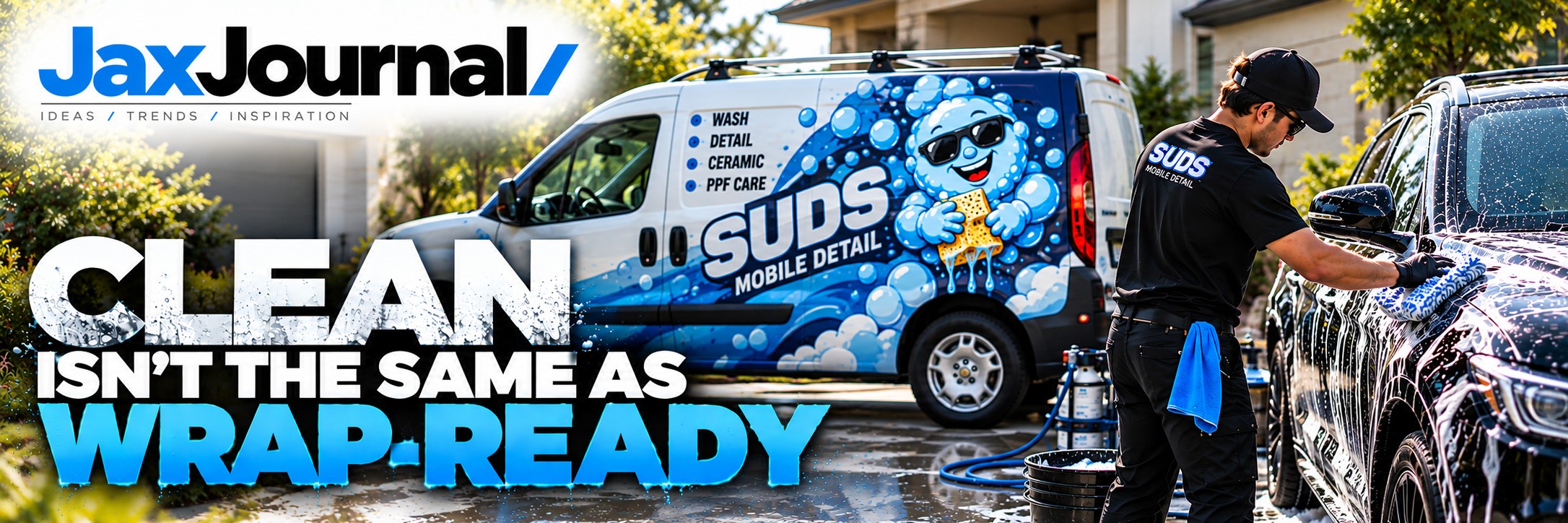
Should You Detail Your Vehicle Before Having It Wrapped?
You’ve scheduled your vehicle wrap. The design is approved. Installation day is approaching.
So naturally, you want to do the courteous thing and bring your vehicle in sparkling clean.
Maybe you even schedule a professional detail a day or two beforehand.
That sounds like the perfect preparation for a vehicle wrap.
It can also be one of the worst things you can do—if your detailer doesn’t know what happens next.
The issue isn’t whether your vehicle is clean. The issue is what was used to make it clean, shiny and protected.
Wax, ceramic coatings, paint sealants and many of the products specifically designed to make automotive paint slick and resistant to contamination can interfere with the adhesive system used by vehicle-wrap films.
So before you have your vehicle detailed ahead of a wrap installation, there’s something your detailer needs to know:
You aren’t preparing the vehicle for a car show. You’re preparing it for vinyl.
Your Wrap Installer Doesn’t Need the Paint to Shine. They Need the Vinyl to Stick.
There is an important difference between a clean vehicle and a wrap-ready vehicle.
Professional automotive detailing is typically designed to leave paint looking its best while protecting the surface afterward. That final step may involve wax, a polymer sealant, ceramic protection, hybrid ceramic products or other surface treatments.
Normally, those are desirable things.
Immediately before a vehicle wrap?
Not so much.
Vinyl manufacturers engineer their adhesive systems to bond to properly prepared surfaces. Anything sitting between the adhesive and the vehicle can potentially interfere with that bond.
That means the goal before installation isn't simply:
Make the vehicle clean.
It's:
Make the vehicle clean without leaving anything behind.
THE BIGGEST RULE: NO WAX
If you remember only one thing before having your vehicle detailed for a wrap, remember this:
Absolutely no wax or paint protection products should be applied.
That includes traditional carnauba wax, synthetic waxes, polymer sealants, silicone-containing products, ceramic coatings, spray ceramics and many of the increasingly common hybrid products combining several of these technologies.
And don't assume that because you didn't specifically request wax, none was applied.
Many detailing packages and automated car washes include some type of wax, sealant or protectant as part of the service.
Terms such as “ceramic wash,” “paint protection,” “premium protectant,” “spray sealant,” “ceramic boost” or “wax and shine” should get your attention if the vehicle is about to be wrapped.
Before choosing a wash or detailing package, ask what's actually being applied to the paint.
WHAT SHOULD YOU TELL YOUR DETAILER?
Communication solves a lot of problems.
When scheduling the detail, don't simply tell the shop you want the vehicle thoroughly cleaned.
Tell them why.
Something as straightforward as this works:
“This vehicle is being prepared for a vinyl wrap. Please do not apply wax, ceramic coating, paint sealant, silicone dressing or any other protective finishing product to surfaces that will receive vinyl.”
A knowledgeable professional detailer will understand the objective.
In fact, an experienced detailer can be an excellent partner in preparing a vehicle for wrapping because they understand automotive surfaces, contamination and the places where dirt and detailing products tend to accumulate.
But they need to know the end goal before they begin.
THE PART EVERYONE FORGETS: EDGES, CRACKS AND CREVICES
This is where preparation becomes particularly important.
Imagine that the broad painted surface of a door has been thoroughly cleaned and stripped of an old wax or ceramic product.
The center of the door may be perfectly suitable for vinyl.
But what about behind the door handle?
Underneath the edge of the hood?
Around the fuel door?
Along a body seam?
Inside the edge of a wheel arch?
Around trim?
Near badges or emblems?
Inside recesses and body lines?
Those areas matter because vehicle wraps don't always stop in the middle of a nice, flat body panel.
Installers frequently need to stretch, tuck, wrap and terminate material around edges and into recessed areas.
If residual wax, ceramic coating, silicone or another protectant remains hidden in those areas, the vinyl may adhere perfectly across most of the panel and then begin lifting precisely where the material needs adhesion the most.
That can create a frustrating situation.
The vehicle looked clean.
The main surface tested clean.
The installation looked great when completed.
Then an edge begins lifting.
This is why removing these products requires more than simply wiping down the obvious painted surfaces. Cracks, creases, edges and recesses deserve just as much attention as the middle of the panel.
DON'T FORGET TIRE SHINE AND TRIM DRESSING
Paint isn't the only concern.
Many professional detailing packages include tire dressing, plastic restoration products and exterior trim treatments.
These products can contain ingredients designed to leave surfaces glossy, dark and water-resistant. They can also transfer or migrate onto surrounding areas.
Wheel openings, rocker panels and lower body surfaces are particularly worth watching.
If your vehicle is headed directly to a wrap shop, consider asking the detailer to skip tire shine and exterior dressings altogether.
Your tires don't need to look ready for a photograph.
Your vehicle needs to be ready for installation.
BE CAREFUL WITH THE “QUICK CAR WASH” BEFORE YOUR APPOINTMENT
Another common scenario sounds completely harmless:
“I ran it through the car wash for you on the way over.”
We appreciate the thought.
But there are two potential problems.
First, some automatic wash packages apply waxes, sealants or ceramic-style protectants during the wash cycle.
Second, a vehicle arriving immediately after a wash can carry significant amounts of trapped water.
Water hides behind mirrors, moldings, handles, badges, weatherstripping, trim pieces, license plates and body seams.
Then, just when the installer thinks everything is dry, another little stream of water appears.
For wrap installation, clean and dry beats freshly washed and dripping every time.
If possible, wash the vehicle sufficiently ahead of the appointment to allow trapped water to evaporate or drain.
WHAT ABOUT BUGS, TAR, SAP AND ROAD CONTAMINATION?
A normal wash isn't always enough.
Vehicles accumulate contaminants that can require additional attention, including:
Road tar
Tree sap
Bug residue
Grease and oil
Adhesive residue
Heavy road film
Environmental fallout
Old waxes and sealants
Some vehicles may also have remnants from previously installed graphics, badges, decals or accessories.
These conditions don't necessarily mean the vehicle can't be wrapped. They simply mean additional preparation may be necessary.
And that's an important distinction:
Cleaning removes dirt. Surface preparation removes things that can interfere with installation.
Those aren't always the same job.
WHAT IF YOUR VEHICLE ALREADY HAS A CERAMIC COATING?
Tell your wrap company.
Even if the coating was applied months—or potentially years—ago.
Don't assume it has completely disappeared simply because water doesn't bead the way it once did.
Ceramic coatings and similar products can create additional preparation requirements before vinyl installation. Depending upon the product, its age and its condition, mechanical or chemical removal may be necessary.
Most importantly, don't have a ceramic coating installed immediately before bringing your vehicle in for a wrap.
If you're buying a new vehicle and the dealership offers paint protection, ceramic coating or another exterior protection package, think carefully before accepting it if wrapping the vehicle is part of your plan.
Applying a product only to pay someone else to remove it shortly afterward doesn't make much sense.
YOUR VEHICLE'S HISTORY MATTERS
Your wrap installer can inspect the vehicle in front of them.
What they can't necessarily see is everything that's happened to it.
Maybe the dealership applied a paint protection product when the vehicle was purchased.
Maybe your detailer ceramic-coated it two years ago.
Maybe you've been using a spray ceramic after every few washes.
Maybe the automated wash you've used for the past year includes a protectant.
That's why disclosure matters.
If you know something has been applied to the paint, tell your wrap company.
Even if you're unsure exactly what the product was.
That information gives the installer an opportunity to evaluate the surface and determine whether additional preparation is appropriate.
SHOULD YOU HAVE YOUR VEHICLE PROFESSIONALLY DETAILED BEFORE A WRAP?
Yes—if the detailer understands why they're doing it.
A professional detailer can do an excellent job preparing a vehicle before a wrap installation.
But there's an important irony here.
A detailer doing an outstanding traditional detail may leave the vehicle beautifully polished, slick, hydrophobic and protected.
Those are normally signs of a job well done.
They just aren't necessarily what your wrap installer wants.
The better instruction isn't:
“Please detail my vehicle before I have it wrapped.”
It's:
“Please prepare my vehicle for vinyl installation.”
Those are two different objectives.
SHOULD YOU POLISH OR PAINT-CORRECT THE VEHICLE FIRST?
Sometimes.
If the paint has oxidation, staining, surface imperfections or other conditions that need correction, polishing may be appropriate before wrapping.
But this is an area where we'd recommend discussing the vehicle with your wrap company before authorizing extensive detailing or paint correction.
Not every imperfection needs to be corrected before vinyl is installed, and some paint conditions may indicate larger issues that need to be evaluated first.
If you're wondering whether the underlying paint itself is suitable for wrapping, we've addressed that subject separately in:
“Is Your Vehicle Actually Ready to Be Wrapped?”
The condition of the substrate matters just as much as its cleanliness.
WHEN IN DOUBT, LET THE WRAP SHOP HANDLE IT
Sometimes you simply don't know.
Maybe you recently purchased the vehicle used.
Maybe you don't know what the previous owner applied.
Maybe the dealership detailed it before delivery.
Maybe you know it was ceramic coated but don't know which product was used.
Or maybe you'd simply prefer to eliminate one more variable before making a significant investment in a vehicle wrap.
That's perfectly reasonable.
At WrapJax, customers who have concerns about previous waxes, sealants, ceramic products or other surface treatments can request additional vehicle preparation before installation.
Depending upon the condition of the vehicle and the amount of preparation required, this service generally ranges from $199 to $249 and can be added to the work order.
It isn't something every vehicle needs.
But when there's uncertainty about what's on the surface, proper preparation is a lot less expensive than discovering an adhesion problem after the wrap has already been installed.
ONE LAST THING: DON'T CONFUSE PRE-INSTALLATION PREP WITH INSTALLATION PREP
Your wrap shop is still going to clean and prepare the installation surfaces before applying vinyl.
That's part of professional installation.
But there's a difference between normal installation preparation and having to remove layers of wax, ceramic coating, silicone, heavy contamination or other products that were applied before the vehicle arrived.
Think of it this way:
The final preparation performed by the installer is the last step.
It shouldn't have to become the first ten steps.
THE SIMPLE PRE-WRAP CHECKLIST
Before bringing your vehicle in for installation:
DO wash the vehicle ahead of time.
DO tell your detailer the vehicle is being prepared for vinyl.
DO disclose ceramic coatings, waxes, sealants and other paint protection products to your wrap company.
DO pay particular attention to edges, seams, recesses and crevices.
DO allow the vehicle enough time to thoroughly dry before installation.
DON'T apply wax.
DON'T apply ceramic coating or spray ceramic.
DON'T use paint sealants or protectants.
DON'T apply tire shine or silicone-heavy exterior dressings immediately before installation.
DON'T assume that a vehicle that looks spotless is automatically ready for vinyl.
And most importantly:
Tell everyone involved what happens next.
Your detailer wants to do a great job.
Your wrap installer wants to do a great job.
Giving both of them the right information helps make sure they're working toward the same goal.
Because when you're investing in a vehicle wrap, the preparation nobody sees can have a tremendous impact on the finished product everyone does.
Clean is good.
Wrap-ready is better.
Was this article helpful?