
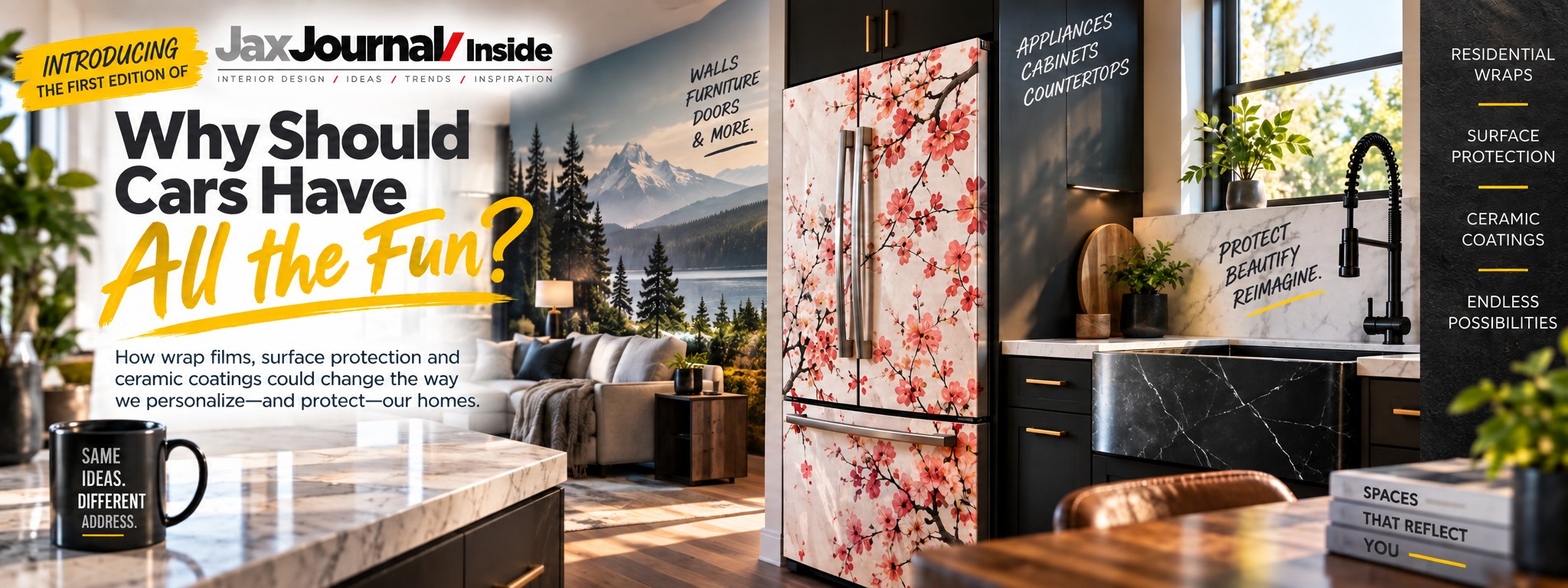
How wrap films, surface protection and ceramic coatings could change the way we personalize—and protect—our homes
For years, some of the most interesting developments in personalization and surface protection have been happening in the automotive world.
We can change the color of a vehicle without repainting it. We can create graphics that would be nearly impossible to reproduce with paint. We can cover vulnerable surfaces with nearly invisible protective films, and then add ceramic coatings that help water, dirt and contaminants release more easily.
Which raises an interesting question:
Why should cars have all the fun?
Many of the same ideas are beginning to make their way through the front door.
Walls, cabinets, countertops, appliances, furniture, glass, doors and other surfaces throughout the home are becoming candidates for a new generation of architectural films, printable materials, protective films and coatings. Instead of automatically replacing something because we don't like its color—or simply accepting that an expensive surface will eventually become scratched, stained or water-spotted—we're gaining another option.
Change the surface without necessarily changing what's underneath it.
Your Refrigerator Doesn't Have to Look Like Everyone Else's
Walk through an appliance showroom and you'll see plenty of beautiful refrigerators.
You'll also see a fairly predictable selection of finishes.
Stainless. Black stainless. White. Black. Maybe a handful of designer colors.
But what if the refrigerator became part of the interior design itself?
Imagine a clean white kitchen with a refrigerator covered in a delicate Japanese cherry-blossom pattern. Or a mid-century kitchen with a subtle geometric design. A lake house could incorporate artwork inspired by the surrounding landscape, while an ultra-modern home could use a brushed-metal, stone or textured architectural finish to visually integrate an appliance into the cabinetry around it.
That's where the experience of the wrap industry starts becoming particularly interesting.
We've spent years learning how to conform materials around curves, corners, handles, recesses and complicated three-dimensional objects. A refrigerator door suddenly doesn't seem particularly intimidating.
And unlike purchasing an expensive appliance in an unusual factory color, a surface treatment can potentially be changed again when the room changes.
Walls Are an Even Bigger Canvas
Of course, wrapping a wall isn't entirely new. Wall murals and commercial environmental graphics have been around for years.
What is changing is the quality, variety and sophistication of the materials.
Today's architectural and graphic films can create everything from custom-printed artwork to convincing wood, stone, metal and textured finishes. Manufacturers are increasingly treating architectural film as a legitimate interior-design material rather than simply an oversized decal.
That creates some fascinating residential possibilities.
A child's bedroom could become a forest, an underwater world or a map of the solar system. A home office could feature a dramatic Pacific Northwest landscape. A dining room could incorporate a mural created specifically for the dimensions of that room. An accent wall could resemble walnut, concrete, marble or another material without necessarily installing the material it imitates.
And because digital printing opens the door to customization, the design doesn't have to come from a catalog.
It could come from you.
Maybe the Best Renovation Is the One You Don't Tear Out
There is another side to this trend that may ultimately prove even more important than personalization.
Sometimes there is absolutely nothing wrong with the thing we're replacing.
The cabinet boxes are solid. The countertop is structurally sound. The doors work perfectly. The built-in desk is fine.
We just don't like what it looks like anymore.
Architectural films create another option: keep the object and change the surface.
That can mean less demolition, less construction debris and considerably less disruption inside an occupied home. It also gives homeowners the ability to experiment with finishes that they might be reluctant to commit to permanently.
This concept fits an increasingly practical approach to remodeling: put resources into the things that genuinely need replacement and reconsider tearing out perfectly serviceable materials simply because their appearance has become dated.
Protection May Be an Even Bigger Opportunity Than Personalization
This is where things get especially interesting.
Think about some of the most expensive and heavily used surfaces in a home.
A large quartz or marble island. A farmhouse sink. Stainless-steel appliances. Bathroom vanities. Shower glass. Dining tables. Built-in desks.
We spend substantial amounts of money selecting these materials—and then immediately begin living on them.
Automotive enthusiasts have dealt with essentially the same problem for years. They purchase an expensive painted surface and then protect it with a transparent sacrificial layer.
The residential version of that concept is already emerging.
Clear surface-protection films designed specifically for interior applications can be installed over compatible countertop materials to help protect against scratches, moisture, contamination and everyday wear. Importantly, these products aren't necessarily the same film being installed on the front of a Porsche; some manufacturers are developing protective films specifically for interior surfaces and human-contact environments.
Imagine protecting the high-use portion of a kitchen island while allowing the stone underneath to remain visible.
Or protecting a desk where children do homework.
Or an expensive tabletop that gets used every day.
Suddenly, the idea of PPF doesn't seem exclusively automotive at all.
It becomes surface protection.
And Then There Is Ceramic Coating
Ceramic coatings create another crossover opportunity, particularly in kitchens and bathrooms.
The objective here isn't to make a countertop indestructible. Ceramic coating doesn't mean you'll never have to clean your kitchen again, and it isn't a substitute for choosing the correct material for the application.
What it can do on compatible surfaces is create a hydrophobic layer that makes it more difficult for water, oils, fingerprints, soap residue and other contaminants to remain attached to the surface.
Consider a farmhouse sink that constantly develops water spots.
Or the stainless refrigerator that seems to acquire another fingerprint five minutes after you clean it.
Or shower glass that repeatedly accumulates mineral deposits and soap residue.
Or the area of a countertop surrounding a frequently used faucet.
These are exactly the kinds of everyday annoyances that hydrophobic surface technology can potentially help address.
And in some applications, the most intriguing solution may eventually be a combination of technologies: a protective film providing a physical barrier, paired with a compatible coating system that makes the exposed surface easier to maintain.
The Outside of the House Is Interesting, Too
The possibilities don't stop at the kitchen door.
Certain exterior applications could open another category entirely.
Glass films can change privacy, appearance and solar characteristics. Exterior architectural films can alter suitable panels and architectural elements. Protective coatings may have applications on outdoor kitchens, glass railings and other hard surfaces constantly exposed to water and contaminants.
Even garages deserve another look.
Cabinetry, toolboxes, workbenches, refrigerators, doors and storage systems offer enormous opportunities for both personalization and protection. For the automotive enthusiast who has spent thousands of dollars creating the perfect garage, wrapping the cabinets or adding a custom graphic wall behind the car isn't much of a conceptual leap.
It's simply extending the personality of the vehicle into the room where it lives.
AI Makes Customization Even More Interesting
Then add AI to the equation.
This may be where residential wraps become dramatically more personal than traditional wallpaper or architectural finishes.
A homeowner could photograph a room and experiment with dozens of ideas before anything is produced. Cherry blossoms across the refrigerator. A subtle mountain silhouette behind the bed. A geometric pattern on an island. Custom artwork in a child's bedroom based on something the child imagined.
Instead of asking, “Which pattern in this catalog do I like?”, the question becomes:
“What would I like to create?”
Once that artwork is properly prepared for production, digital printing means the finished surface can potentially be something no other home has.
That moves wrapping away from simply being an alternative material and turns it into another form of interior personalization.
Not Everything Should Be Wrapped
There is an important caveat to all of this.
Just because a material can stick to something doesn't mean it belongs there.
Heat, moisture, food-contact requirements, surface porosity, texture, cleaning chemicals, edge exposure and the condition of the underlying substrate all matter. Countertops require different considerations than walls. A sink presents very different challenges from a refrigerator. Exterior surfaces introduce UV exposure and weather.
The same is true of coatings.
Every material needs to be evaluated for the surface and environment where it will actually be used, and manufacturer specifications should determine whether a particular film or coating is appropriate.
That's an important distinction because this isn't about finding creative places to stick leftover automotive vinyl.
It's about applying the knowledge developed by the wrap and surface-protection industries to an entirely different environment using materials engineered for those applications.
Maybe We Need to Stop Thinking About "Wraps"
For nearly two decades, we've thought about our industry largely in terms of vehicles.
Commercial wraps.
Color-change wraps.
Paint protection film.
Fleet graphics.
But perhaps the more interesting future is simply surface transformation.
The skills are surprisingly transferable: understanding adhesives, preparing surfaces, working around corners and contours, creating seamless transitions, digital printing, laminating, precision cutting and protecting the finished surface.
The canvas is what's changing.
A refrigerator can become artwork.
A wall can become a landscape.
A dated cabinet can become contemporary.
An expensive countertop can gain another layer of protection.
A farmhouse sink can potentially become easier to maintain.
And a room that once required demolition to dramatically change its appearance may increasingly be transformed by changing only its surface.
We've spent years asking people what they would do if they could make their vehicle look like anything they wanted.
Maybe it's time to ask the same question about their home.
If almost any surface could become a canvas—or something worth protecting—what would you do with yours?