A Little Extra Value from WrapJax - $50 & $100 OFF. Absolutely FREE!
Read More
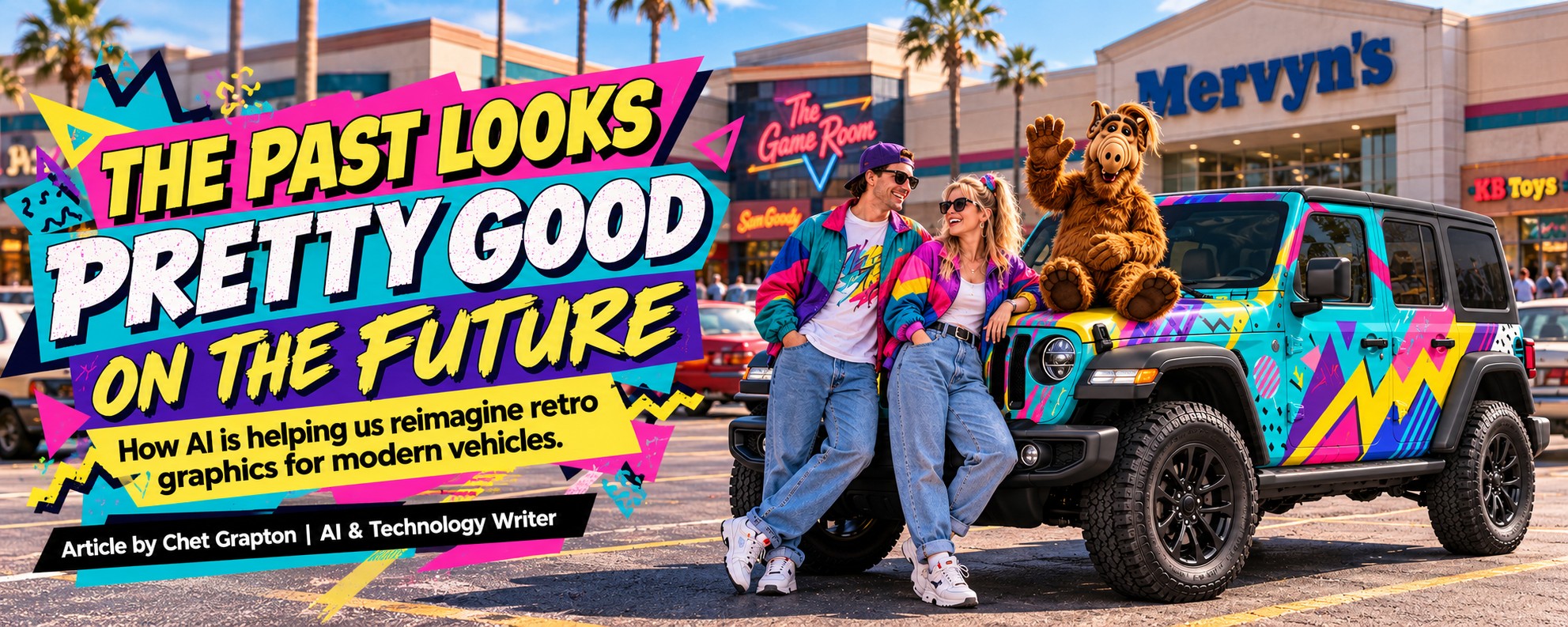
How AI is helping us reimagine retro graphics for modern vehicles.
ByChet GraptonStaff AI & Technology Writer Chet GraptonStaff AI & Technology Writer
There’s something wonderfully strange about using one of the newest technologies available to create something that looks like it could have come straight out of 1987.
Artificial intelligence has quickly found its way into writing, photography, architecture, fashion, advertising and just about every other creative field you can think of. Vehicle graphics are no exception. But one of the things I find most interesting about AI as a creative tool has nothing to do with making things look futuristic. In fact, it’s almost exactly the opposite.
AI gives us a surprisingly good way to look backward.
Imagine a brand-new Ford Bronco wearing a graphic package that looks like something you might have found in a 1979 dealership brochure. Maybe it’s a new Tacoma with stripes inspired by an early-'80s BMX bike, a Tesla borrowing colors from a 1990s surf shop, or a Rivian wearing earth-tone graphics reminiscent of an old adventure vehicle you might have seen parked at a campground 40 years ago.
None of those vehicles existed during those eras, of course, and that’s exactly what makes the exercise so much fun.
NOSTALGIA WITHOUT THE OLD CAR
Automotive design has always reflected the period in which a vehicle was created, and you really don’t have to be a designer to recognize many of those eras when you see them.
The 1970s gave us earthy colors, sunset stripes and combinations of brown, orange, yellow, cream and tan that would be difficult to mistake for almost any other decade. The 1980s became brighter and sharper, bringing angular striping, neon accents and influences from BMX, skateboarding, surfing, motorsports and the emerging computer age. By the 1990s, teal, purple and magenta seemed to be everywhere, while gradients, splashes, squiggles and abstract patterns showed up on everything from snowboards and mountain bikes to jackets, disposable cups and vehicles.
Then came the early 2000s, with another completely different visual language heavily influenced by tuner culture, action sports and increasingly elaborate automotive graphics.
A lot of those styles eventually disappeared as automotive design became cleaner and more restrained. The funny thing is that the memories attached to them never really went away. If you grew up during one of those periods, a certain combination of colors or the shape of a stripe can immediately transport you somewhere you haven’t thought about in years.
That’s where AI starts getting interesting.
SOMETIMES YOU KNOW THE FEELING, NOT THE DESIGN
One of the more difficult parts of creating a custom vehicle graphic has always been explaining what you want when you don’t necessarily have the design vocabulary to describe it. Most people aren't walking into a wrap shop talking about geometric composition, typography styles or color relationships. They just know what they like when they see it.
Someone might say, “I want my truck to look like something I would have seen outside a BMX shop in 1987.”
That may not sound like a conventional design brief, but it’s actually a pretty good one.
The same person could say, “Make my new Bronco look like Ford offered a special graphics package for it in 1979,” or, “Give my SUV the personality of a 1992 surf shop, but don’t make it look like a race car.” Those descriptions communicate quite a bit. They contain cultural references, memories and a general feeling that can sometimes be much harder to convey with a collection of design terminology.
This is one of the areas where AI can be genuinely useful. You can explore decades, color combinations, stripe widths, graphic placement and completely different directions without spending hours manually developing every idea from scratch. You’re not necessarily creating the finished wrap at this point. You’re figuring out what you like, what you don’t like and where the idea might go next.
In that sense, AI becomes less of a designer and more of an incredibly fast sketchbook.
PARTIAL WRAPS MAY BE THE SWEET SPOT
This idea gets particularly interesting when you start thinking about partial wraps because a retro-inspired vehicle doesn’t necessarily need to be completely covered in vinyl. In many cases, leaving a significant amount of the factory paint exposed actually makes the design feel more authentic.
Think about a white modern SUV with burnt orange, mustard yellow and brown graphics running along the lower body, or a black pickup with teal, purple and hot-pink geometry sweeping across the rear quarter panels. The existing paint becomes another color in the design rather than something that needs to be hidden.
There’s also something about that approach that can make a vehicle look more like it came with a special factory graphics package rather than simply looking “wrapped.” Anyone who remembers some of the appearance packages offered on trucks, vans and SUVs decades ago probably knows exactly what I mean. The graphics complemented the vehicle rather than completely transforming it.
That’s really the opportunity here. We aren't necessarily trying to make a new vehicle look old. We’re imagining what a designer from another era might have done if today’s vehicle had somehow been sitting in front of them.
AI CAN DRAW THE PICTURE. SOMEBODY STILL HAS TO BUILD IT.
There is an important reality check in all of this.
A beautiful AI-generated picture of a wrapped vehicle is not the same thing as production-ready vehicle wrap artwork.
AI doesn’t always understand where every door seam falls, how a body panel changes direction or what happens to a graphic when it travels around a wheel arch. It may happily run an important part of a design through a door handle, camera or sensor. It can invent body lines that aren't there, change the shape of the vehicle from one image to the next or produce graphics that look fantastic from one angle but would be nearly impossible to reproduce consistently on both sides of an actual vehicle.
That doesn't make the image useless. Far from it. It just means we need to understand what part of the process AI is actually helping with.
Once an idea moves from inspiration to an actual wrap project, someone still needs to translate that concept onto the real vehicle. Accurate measurements or templates have to be used. Graphics need to work around actual panels and hardware. Colors and materials have to be selected, artwork has to be prepared at a quality suitable for printing, and ultimately an installer has to make the whole thing work on a complicated three-dimensional surface.
AI can do a remarkable job of helping answer the question, “What could this look like?”
The designer, production team and installer still have to figure out, “Okay, now how do we actually make it?”
That distinction matters.
DON'T COPY THE PAST. BORROW FROM IT.
I think the really interesting results start happening when you stop asking AI to reproduce something that already existed.
There’s nothing particularly creative about taking an old stripe package from a 1985 pickup and simply reproducing it on a new one. It might look great, and there’s certainly nothing wrong with doing that if it’s what someone wants, but AI gives us an opportunity to take the idea considerably further.
Instead, borrow the vocabulary of the era. Take the colors, typography, proportions, geometry and attitude and then build something new from those ingredients.
An '80s-inspired wrap doesn’t have to copy an old Toyota stripe kit. It could borrow the angular geometry and energetic colors associated with that period and reinterpret them around the much more sculpted body lines of a 2026 vehicle. A '90s-inspired design doesn't need to recreate a specific snowboard graphic either. Maybe it simply borrows that era's colors, looseness and sense of fun.
That's when nostalgia stops being reproduction and starts becoming design.
YOUR MEMORY MIGHT BE THE BEST PROMPT YOU HAVE
This might be my favorite part of the whole idea because you don’t necessarily need to begin with artwork. You can start with a memory.
Maybe it was the graphics on your first BMX bike or the colors on the arcade cabinet you played after school. It could be a skateboard deck, a snowboard you owned in 1994, your dad’s old pickup, the sign hanging outside a surf shop you visited every summer or even the colors on a ski jacket you haven't thought about in 30 years.
Maybe it was a cassette tape, a pair of sneakers, an old magazine advertisement or something sitting in the background of a family photograph.
Any of those things can become the beginning of an idea.
You can show AI a reference image or simply describe what you remember and begin exploring. The first result probably won't be exactly right. Neither will the second. That's okay. The interesting part is being able to continue the conversation: make the stripe wider, lose the purple, add more orange, move the graphics toward the rear, make it feel more 1978 than 1988, simplify it, make it look more like something a manufacturer would have actually offered.
Little by little, the memory starts turning into something tangible.
THE FUTURE DOESN'T ALWAYS HAVE TO LOOK FUTURISTIC
There has been a tendency, especially with AI-generated imagery, to associate the future with glowing lights, cyberpunk cities, metallic surfaces and vehicles that look like they belong in a science-fiction movie.
But technology doesn't dictate the aesthetic. It's just another tool.
Sometimes one of the most interesting things you can do with a new tool is use it to rediscover something old. A modern SUV can wear colors from the 1970s. A new EV can borrow from 1980s arcade culture. A 2026 pickup can look like it just rolled out of a 1991 snowboard catalog, even though neither the truck nor the technology used to imagine the design existed back then.
And because we're talking about vinyl graphics rather than permanently repainting the vehicle, there's another nice part to the story: you don't necessarily have to live with that decision forever. You can have some fun with it.
Maybe that's ultimately why I like this idea so much. We're using technology that represents where we're going to explore the colors, styles and memories of where we've already been. It’s an unusual collision of two completely different periods, with a modern vehicle sitting right in the middle of it.
And as it turns out, the past can look pretty good on the future.
Article by Chet Grapton | JaxJournal AI Contributing Writer
Was this article helpful?