
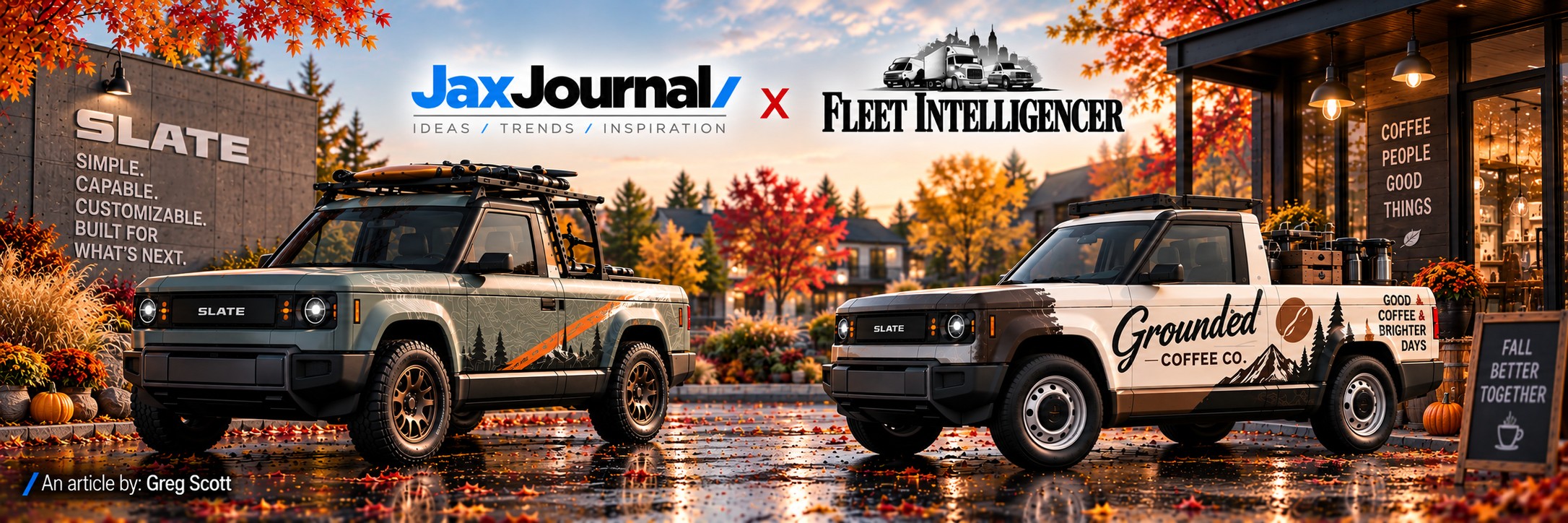
Slate Isn't Just Building a Small Electric Truck. It May Be Building One of the Most Interesting Platforms for Vehicle Personalization and Fleet Branding We've Seen in Years.
A JaxJournal × Fleet Intelligencer Exclusive
Every once in a while, a new vehicle comes along that is interesting not necessarily because it has more horsepower, a larger touchscreen or another collection of electronic features, but because someone decided to rethink a fundamental assumption about how automobiles are supposed to be built.
The upcoming Slate Truck may be one of those vehicles.
Backed by investors that include Jeff Bezos' family office, Slate Auto has attracted considerable attention with a remarkably simple proposition: build a useful, compact electric pickup without loading it with features many buyers don't necessarily need, sell it at a price dramatically below the average new vehicle, and allow customers to add the things they actually want over time.
The resulting vehicle is appropriately called the Blank Slate.
And perhaps the most interesting part of that philosophy—at least from our perspective—is that Slate has decided that vehicle wraps shouldn't simply be something customers add after purchasing the vehicle.
Wrapping the vehicle is actually part of the vehicle's design philosophy.
What If the Factory Didn't Decide Your Color?
Automobile manufacturers have traditionally spent enormous amounts of money building and operating paint facilities so customers can choose among a relatively small selection of factory colors.
Slate looked at that process and essentially asked a different question:
What if we didn't paint it at all?
Every Slate is designed to leave production with unpainted Slate Gray composite exterior panels. Customers who want another color can choose a vehicle wrap instead.
That decision accomplishes two things simultaneously. It helps simplify manufacturing and reduce costs while transferring considerably more creative control to the person purchasing the vehicle.
Instead of choosing among six or seven factory colors, Slate says customers will be able to choose from more than 100 wrap colors in gloss, satin and matte finishes, along with partial wraps, decals, signature designs and completely custom colors.
Full wrap material is currently advertised by Slate starting below $500, with professional installation targeted to begin around another $500. Partial wraps and decals can cost even less.
In other words, Slate hasn't merely acknowledged the vehicle wrap industry.
It has incorporated wrapping directly into the business model.
A $24,950 Truck Arriving in a $50,000 Automobile Market
Timing may prove to be one of Slate's greatest advantages.
The Blank Slate Truck now carries an announced starting price of $24,950, plus destination charges, at a time when the average new vehicle transaction price in America has climbed above $50,000.
That puts Slate's entry price at roughly half the cost of the average new vehicle.
The truck itself is intentionally simple. It begins life as a two-seat, rear-wheel-drive electric pickup rather than attempting to compete with today's increasingly luxurious full-size trucks. Slate has removed many of the things that have gradually become standard equipment elsewhere and instead created an extensive catalog of accessories customers can add when—or if—they want them.
Want additional features? Add them.
Want different wheels? Add them.
Want to transform the pickup into a five-passenger SUV? Slate has designed conversion systems for that too.
Want a different color?
Wrap it.
Slate currently advertises more than 200 accessories, with more than 80 percent priced below $500. The underlying philosophy is remarkably different from the trim-package structure consumers have become accustomed to: buy the basic vehicle and then build the version that makes sense for you.
Small Truck. Surprisingly Big Interest.
Whether that idea ultimately succeeds will be determined after production vehicles reach customers, but early consumer interest suggests Slate has touched a nerve.
The company reported more than 160,000 reservations by April 2026, and more recent reporting puts that number above 180,000. Slate opened preorders June 24, requiring a $300 nonrefundable deposit—or $250 for customers who previously placed the original $50 reservation—and more than 10,000 customers reportedly converted to preorders shortly after pricing was announced.
First deliveries are officially expected in late 2026, with some customers recently being presented with delivery windows beginning as early as December.
Slate also completed a $650 million Series C financing round in April 2026, bringing its reported funding to roughly $1.4 billion as it prepares the Warsaw, Indiana, manufacturing operation for production.
Of course, reservations and preorders don't guarantee long-term automotive success. Building prototypes and generating excitement are considerably different challenges from manufacturing thousands of reliable vehicles, establishing service infrastructure and supporting customers over many years.
Slate still has plenty to prove.
But there is another statistic worth considering.
Ford sold 155,051 Mavericks in the United States during 2025, making it the Maverick's strongest sales year yet. Through August 2026, another 110,913 had already been sold.
That tells us something important.
Americans apparently haven't lost interest in pickup trucks.
They may simply be interested in smaller, more affordable ones.
The Numbers Behind the Slate
For such a compact vehicle, the Slate's specifications make it potentially useful for considerably more than commuting.
The Blank Slate is approximately 174.6 inches long, with a 108.9-inch wheelbase, making it significantly smaller than the enormous pickups that increasingly dominate American roads.
The bed measures approximately five feet long with the tailgate closed and nearly 6.8 feet with it lowered. Early specifications list payload capability above 1,400 pounds, although Slate continues to note that final production specifications remain subject to change.
The rear-mounted electric motor produces approximately 201 horsepower, and the current production configuration is expected to deliver about 205 miles of range.
Perhaps more important for commercial users is the simplicity underlying all of it.
Slate describes the vehicle as having fewer than half the parts of a typical vehicle, and its fleet messaging specifically emphasizes reducing unnecessary complexity and therefore the number of things that potentially require service or repair.
For an individual owner, simplicity can mean affordability.
For a fleet manager, simplicity can mean something else entirely:
uptime.
This Is Where Slate Gets Particularly Interesting for Fleets
Imagine a plumbing company, HVAC contractor, pest-control company, property-management operation, security company, municipal department or local delivery business purchasing ten Slate Trucks.
Traditionally, those vehicles would arrive from the manufacturer in whichever factory color the company selected. The fleet graphics provider would then apply branding over that paint.
Slate potentially flips that process around.
If the vehicle is already intended to receive a wrap, the company's fleet graphics don't necessarily have to be something applied over the finished vehicle.
The fleet graphics can become the finished vehicle.
Instead of ordering ten white trucks and then adding logos, phone numbers and graphics, a business could potentially design the entire exterior treatment around its brand from the beginning.
Company colors become vehicle colors.
The logo becomes part of the overall design.
Different departments could receive different graphic treatments while retaining the same underlying vehicle platform.
Seasonal campaigns could be changed.
A vehicle transferred from one division to another could be rebranded.
A used fleet vehicle could potentially be stripped and prepared for resale without permanently painting it in a highly specific corporate color.
For companies operating larger fleets, that opens an interesting conversation about fleet standardization without visual standardization.
The underlying vehicles can all be identical while their exterior identities remain completely flexible.
Then Slate Called Crayola.
If anyone still doubted whether Slate considers vehicle wraps central to the company's identity, its newest collaboration should settle the argument.
Slate recently partnered with Crayola on what the companies describe as Crayola's first automotive collaboration.
And yes, the colors sound exactly like you'd hope they would.
Customers can choose limited-edition treatments based on five recognizable Crayola colors:
Dandelion. Razzmatazz. Cerulean. Jersey Tomato. Fern.
The packages go beyond simply putting colorful vinyl on a truck. Slate is pairing the wraps with matching graphics and accessories, turning the vehicle into something closer to a limited-edition design collection.
It's playful marketing, certainly.
But underneath the fun is a much more interesting idea.
Slate is demonstrating that a vehicle manufacturer no longer has to create a special paint color, interrupt manufacturing, manage additional paint inventory and produce a limited factory edition simply to collaborate with another brand.
The collaboration can exist largely through the vehicle's exterior graphics and accessories.
Today it's Crayola.
Tomorrow it could theoretically be an outdoor brand, sports franchise, artist, university, fashion label, entertainment property or countless other collaborations.
Slate has also begun working with artists, including New York artist Max Kolo, further reinforcing the idea that the vehicle itself can function as a creative platform.
That begins to blur the traditional boundary between automotive manufacturing, customization and branding.
A Vehicle That Can Change Along With Its Owner
There is also something refreshingly impermanent about the concept.
Automobiles typically become less personal over time. We choose the configuration when we purchase them, and five years later we're essentially driving the same combination of color, wheels and trim that we selected on day one.
Slate is encouraging customers to think differently.
Maybe you buy the truck in gray.
Maybe six months later you wrap it green.
Maybe two years later you decide you want something completely different.
Maybe the pickup configuration works today, but several years from now your lifestyle changes and the SUV configuration makes more sense.
That philosophy feels particularly compatible with the way younger consumers have grown accustomed to personalizing nearly everything else they own.
We change the case on our phones. We customize our computers. We change watch faces, wallpapers, clothing styles and home décor.
Why should the appearance of a vehicle remain essentially frozen for ten years?
AI Makes the Blank Slate Even More Interesting
There is another technological development happening at exactly the right time for a vehicle like this.
Artificial intelligence has dramatically lowered the barrier between having an idea and being able to visualize it.
A Slate owner doesn't necessarily have to begin by flipping through a catalog of existing wrap designs. Someone can use ChatGPT, Grok or another AI creative platform and begin asking a much more interesting question:
What would my Slate look like if…?
What if it were inspired by a 1980s off-road truck?
What if the original gray remained visible but a geometric graphic wrapped around the rear quarter?
What if a business used its existing logo and corporate colors to develop a complete fleet design?
What if a landscaper wanted something rugged and understated while a coffee company wanted something colorful enough to become instantly recognizable around town?
The creative starting point has changed.
The challenge becomes translating that concept into a properly engineered vehicle graphic that can actually be printed, produced and installed.
And that's where things become particularly interesting for us.
WrapJax.ai and Fleetwraps.ai Are Getting Ready for the Slate
With Slate deliveries approaching, WrapJax.ai and Fleetwraps.ai are preparing early.
Our goal is to have access to the Slate platform and a professionally prepared vehicle template so that when these trucks begin reaching customers, we aren't starting the design process from scratch.
For an individual customer using WrapJax.ai, that means an AI-generated concept can move more quickly from an inspirational rendering toward an actual production-ready vehicle wrap.
For commercial customers using Fleetwraps.ai, the implications can be even greater.
Fleet branding frequently involves far more than designing graphics. Measurements have to be verified. Templates have to be established. Designs need to accommodate body lines, panels, handles, seams and other physical characteristics of the vehicle. When a new model enters a fleet, that development work can create additional lead time before the first branded unit is ready for service.
Having the Slate templated in advance is intended to compress that process.
A business considering Slate vehicles for an upcoming fleet deployment could begin developing the branding program while vehicles are still working their way through procurement.
Vehicle ordered. Graphics developed. Production prepared. Vehicle arrives. Wrap installed. Vehicle goes to work.
That's the kind of workflow fleet managers appreciate.
Maybe Slate's Biggest Innovation Isn't Electric
It's easy to categorize the Slate as another electric vehicle startup.
That may ultimately undersell what's interesting about it.
Yes, it's electric. Yes, it's inexpensive relative to much of today's new-vehicle market. And yes, a compact pickup starting at $24,950 is going to attract attention.
But Slate's more consequential idea may be that an automobile doesn't necessarily need to leave the factory completely finished.
Instead, the manufacturer can create a standardized platform and let the customer participate in determining what the finished product becomes.
For an individual, that means personalization.
For an artist, it means a canvas.
For a company, it means branding.
For a fleet manager, it means adaptability.
And for the vehicle wrap industry, it represents something we've been saying for years suddenly being validated by an automobile manufacturer:
A wrap doesn't have to be an afterthought. It can be part of the vehicle from the very beginning.
Slate calls it a Blank Slate.
We think that's exactly what makes it interesting.
JaxJournal × Fleet Intelligencer
WrapJax.ai | Fleetwraps.ai