
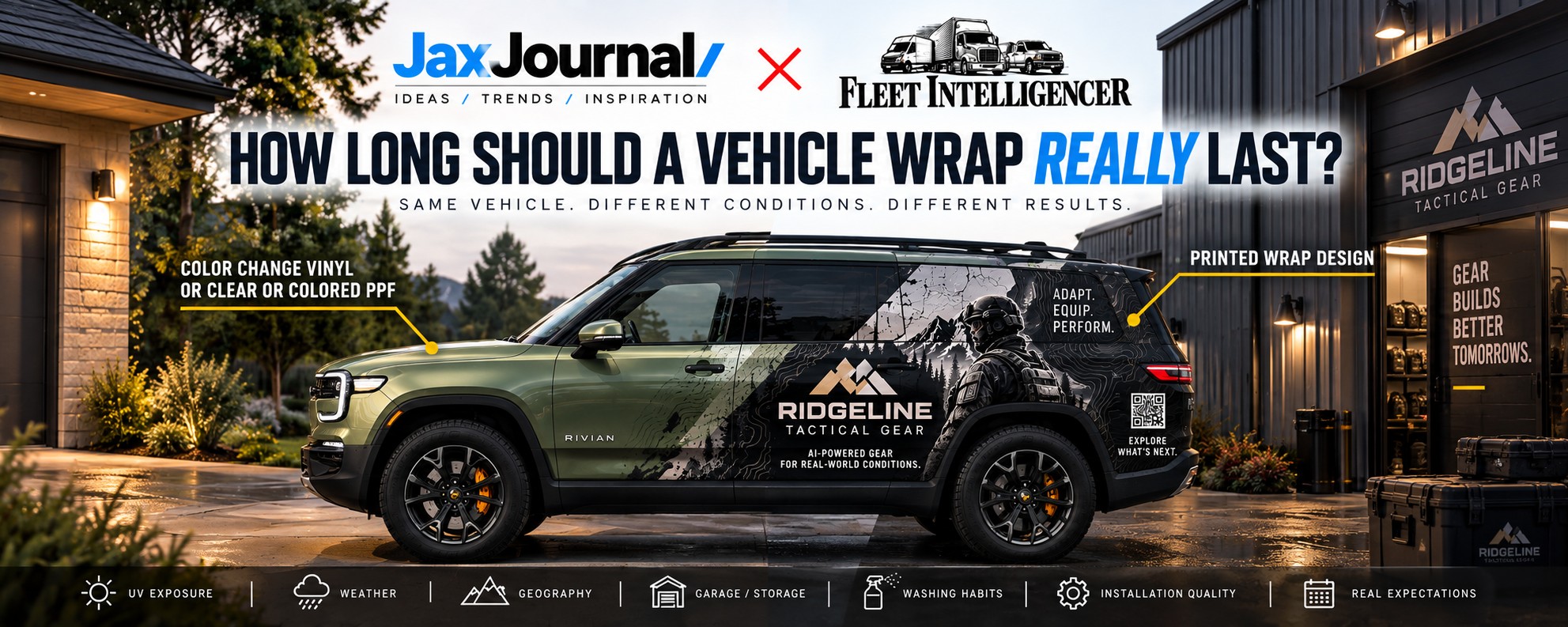
The answer isn't simply a number of years. Where you live, where you park, how you wash your vehicle—and even which direction a particular body panel faces—can make a considerable difference.
A JaxJournal x Fleet Intelligencer Exclusive
Ask how long a vehicle wrap should last and you'll probably hear an answer somewhere in the neighborhood of five to seven years.
It's a convenient answer. It just isn't a particularly complete one.
The reality is that a vehicle wrap doesn't have a single expiration date. Different portions of the same wrap can age at different rates, and two identical vehicles wrapped with exactly the same material on exactly the same day can look considerably different several years later depending upon where they're driven, how they're stored and how they're maintained.
For an individual spending thousands of dollars changing the appearance of a vehicle, that's important information. For a business investing in graphics across an entire fleet, it becomes even more important because wrap longevity affects appearance, brand consistency, replacement schedules and ultimately the long-term cost of maintaining that fleet.
So, how long should a vehicle wrap really last?
The better answer begins with understanding what manufacturers actually mean when they talk about durability.
A Warranty Isn't Necessarily an Appearance Guarantee
One of the easiest mistakes to make when researching vehicle wrap materials is seeing a manufacturer's published warranty or durability rating and assuming that's exactly how long your wrap will continue looking new.
Those aren't necessarily the same thing.
Manufacturers establish specific conditions around their warranties, including the material being used, geographic region, orientation of the installed film and proper installation and maintenance. They may also distinguish between defects covered under warranty and ordinary changes in appearance caused by normal use.
Avery Dennison, for example, specifically notes in its product documentation that factors including surface preparation, application methods, the angle and direction of sunlight, environmental conditions, cleaning and maintenance can reduce durability. It also identifies abrasion and loss of gloss as normal wear rather than conditions covered by its warranty.
That's an important distinction.
A film may still be adhering perfectly well to the vehicle while showing signs of age that an owner—or a company protective of its brand image—decides are no longer acceptable.
In other words, manufacturer warranty, material durability and useful cosmetic life aren't necessarily synonymous.
Your Hood and Your Door Live Very Different Lives
This may be one of the least understood aspects of vehicle wrap longevity.
A wrap doesn't experience the environment equally across the entire vehicle.
Consider the doors on a typical car, truck or van. They're primarily vertical surfaces. Now compare those with the hood, roof and upper surfaces of the vehicle. Those areas receive substantially different exposure to sunlight and weather.
Manufacturers recognize this difference in their warranty programs.
3M currently states that its Wrap Film warranty can extend up to eight years for vertical exposure and up to three years for horizontal exposure, depending upon the applicable conditions. The company also specifically points out that whether film is installed on a vertical surface such as a door or a non-vertical surface such as a hood or roof affects warranty duration.
Avery Dennison similarly separates vertical, non-vertical and horizontal exposure in its technical guidance.
This explains something vehicle owners sometimes encounter several years into ownership: the sides of the vehicle may still look terrific while the hood or roof begins showing noticeably more age.
Nothing mysterious happened to the vinyl. Those surfaces simply haven't lived the same life.
Geography Matters More Than You Might Think
A wrapped vehicle spending its life in Western Washington doesn't experience the same environment as an identical vehicle operating in Phoenix, Las Vegas or another hot, high-UV climate.
Film manufacturers know this, which is why geographic or climatic zones appear in many durability and warranty specifications.
ORAFOL, for example, explains in its current vehicle-film application guidance that published maximum durability values depend upon both environmental conditions and film orientation, with different climate zones receiving different durability considerations.
That doesn't mean rain and cooler temperatures make the Pacific Northwest harmless to vehicle graphics. Moisture, contaminants, road grime, freeze-thaw cycles and long periods outdoors all contribute their own stresses.
But it does illustrate why asking someone in one part of the country how long their wrap lasted doesn't necessarily tell you how long yours will.
Where the vehicle lives matters.
The Garage May Be One of the Best Wrap-Care Products You Own
People often ask what product they should buy to extend the life of their wrap.
Sometimes the most valuable answer isn't something that comes in a bottle.
It's a garage.
UV exposure and environmental contamination accumulate over time. A vehicle parked indoors every night and another sitting outside 24 hours a day simply aren't experiencing equivalent conditions.
Even 3M advises vehicle owners that storing a wrapped vehicle indoors when possible can help protect the appearance and life of the wrap.
For a personal vehicle, that may mean using the garage rather than letting the garage gradually become storage space while the car lives in the driveway.
For commercial fleets, indoor parking often isn't practical. What is practical is recognizing outdoor exposure when developing a graphics lifecycle plan. A fleet operating outdoors around the clock shouldn't necessarily use the same replacement assumptions as a lightly driven executive vehicle that spends nights inside.
How You Wash It Matters Too
Vinyl isn't paint, although quality wrap films are engineered to tolerate the realities of automotive use.
Regular cleaning is important because contaminants shouldn't be allowed to remain on the surface indefinitely. Bird droppings, insects, tree sap, road contaminants and other substances are best addressed promptly rather than becoming permanent residents of the wrap.
At the same time, aggressive cleaning can create its own problems.
3M recommends regular cleaning and identifies careful hand washing with a mild detergent or an appropriate brushless car wash as suitable approaches for its wrap film, while advising against certain wax options.
The specific care recommendations can vary by film and finish, so the best approach is always to follow the guidance for the material actually installed on the vehicle.
That becomes particularly important with matte, satin, textured and specialty finishes, which can respond differently to cleaners, waxes and polishes than conventional gloss materials.
Material Selection Makes a Difference
Not every piece of vinyl marketed for graphics is intended to perform the same job.
Premium cast vehicle-wrap films are engineered specifically to conform around automotive contours while tolerating outdoor exposure, temperature changes and eventual removal. Printed commercial wraps add another component to the equation because the printed film is generally paired with an overlaminate designed to protect the print.
Even within those categories, durability can differ.
Avery Dennison, for example, currently lists certain DOL Max overlaminates at up to seven years of vertical durability and two years of horizontal durability. Its DOL 7460 polyurethane overlaminate is listed at up to six years vertically and three years horizontally under applicable conditions.
The point isn't that one number is universally better than another. It's that the construction of the wrap matters, and the material should be selected according to what the vehicle is expected to do.
A fleet van traveling thousands of miles every month has different priorities than a weekend sports car undergoing a color change.
Installation Quality Can Affect What Happens Years Later
Even exceptional film can't compensate for poor preparation or installation.
Before installation, the vehicle needs to be properly cleaned and evaluated. Contamination around edges, improper surface preparation, excessive stretching, insufficient post-heating in critical areas and poorly executed seams or edges can all influence how a wrap performs.
ORAFOL's current application guidance specifically states that improper application, removal or use of a film unsuitable for the particular application can significantly reduce film durability.
Professional installation isn't simply about making the vehicle look good on delivery day. Some of the most important installation decisions reveal their value months or years later.
Personal Vehicles and Fleet Vehicles Have Different Definitions of “Still Looks Good”
This is where the conversation becomes especially interesting.
An enthusiast who selected a satin green color-change wrap may tolerate some normal aging because they still love the appearance. Another owner may decide after three years that they're simply ready for a different color.
Commercial fleets operate under a different standard.
A wrap is part of the company's public-facing identity. If ten newer vehicles have vibrant, consistent graphics while three older vehicles have noticeably faded hoods and roofs, customers don't see the manufacturer's technical durability rating.
They see the brand.
That means fleet managers should think about wrap replacement as part of fleet lifecycle management, rather than waiting for vinyl to physically fail.
A commercial wrap can still be attached to the vehicle and technically performing its job while no longer presenting the image the company wants representing its brand.
Mileage Isn't the Same Thing as Age
There's another variable worth considering: how the vehicle is actually used.
A five-year-old personal vehicle driven 6,000 miles annually and stored in a garage has experienced a very different life from a five-year-old service van that has traveled 30,000 miles every year.
The commercial vehicle has accumulated dramatically more exposure to road debris, washing, contamination and everyday operational wear.
That's why age alone isn't always the best way to schedule fleet graphics replacement.
Condition matters.
For larger fleets, periodic visual inspections can be far more useful than simply putting a replacement date on the calendar. Hoods, roofs, leading edges, rocker panels and high-contact areas can be examined separately from the vertical sides of the vehicle.
Sometimes the solution isn't even replacing the entire wrap.
So, What's the Real Answer?
If you're looking for a universal number, there isn't one.
A professionally installed wrap made with quality automotive film can provide years of excellent service, but its actual cosmetic lifespan depends upon a combination of material, film orientation, climate, UV exposure, vehicle storage, mileage, cleaning practices, installation quality and the owner's expectations.
That's why the better question isn't:
“How many years will my wrap last?”
It's:
“How long should I expect this particular wrap, on this particular vehicle, used in this particular environment, to continue looking the way I want it to look?”
That's a question an experienced wrap professional can answer much more intelligently.
Think About Removal Before Installation
There's one final piece of the longevity conversation that often gets overlooked.
A vehicle wrap is intended to be temporary.
That doesn't mean temporary in the sense of weeks or months. It means the film was designed with an expected service life, and leaving aging vinyl on a vehicle indefinitely isn't necessarily advantageous.
As a wrap approaches the end of its useful life, removal should become part of the conversation—not something postponed until the material has deteriorated dramatically.
For a personal vehicle, that might be the perfect opportunity to return to the original paint or completely reinvent the vehicle with another color.
For a business, it may coincide with refreshed branding, reassignment of the vehicle, resale, lease return or installation of a new generation of fleet graphics.
Either way, the smartest wrap lifecycle doesn't begin when the old vinyl starts failing.
It begins on the day the new wrap is installed.
At WrapJax.ai and FLEETWRAPS.ai, we believe customers should understand not only what their wrap will look like when it's new, but what they can realistically expect from it over the years that follow. Material selection, professional installation, proper care and a sensible replacement strategy all contribute to getting the greatest value from that investment.
Because the best measure of a vehicle wrap isn't simply how long you can leave it on.
It's how long you're proud to leave it on.