
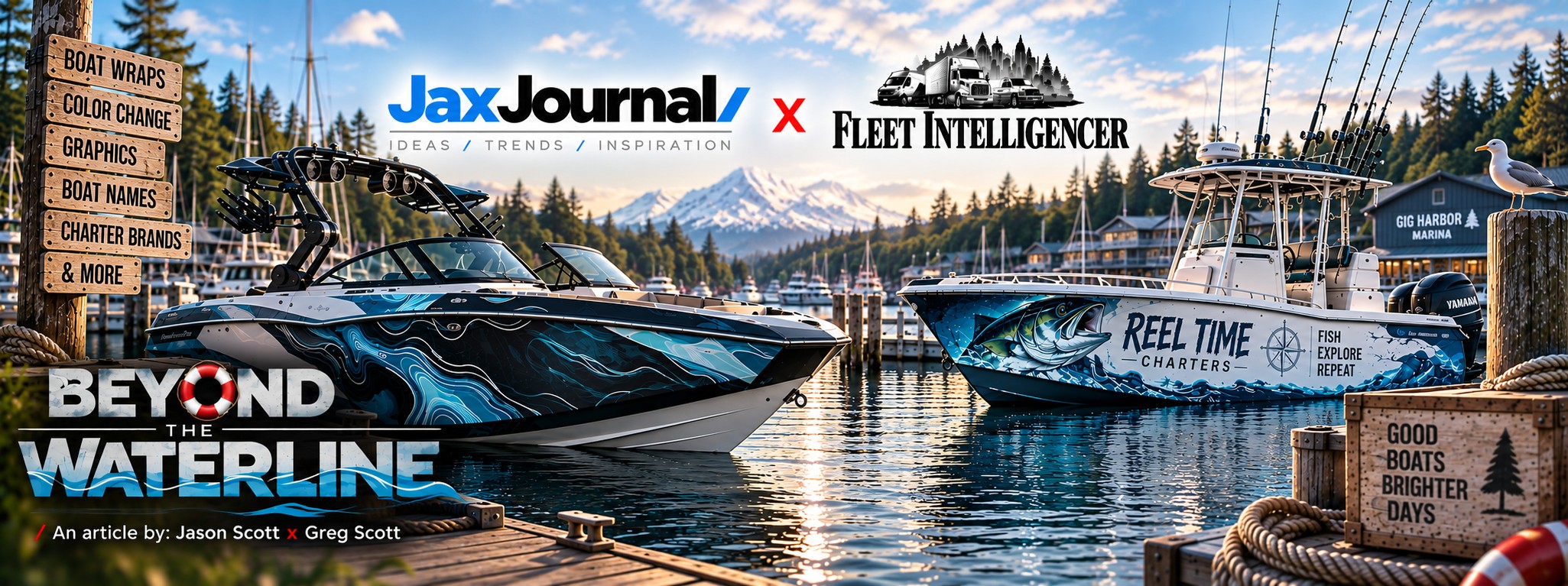
From Fishing Boats and Wake Boats to Sailboats, Catamarans and Yachts, the Wrap Industry Is Discovering That Some of Its Most Interesting Vehicles Don't Have Wheels.
A JaxJournal × Fleet Intelligencer Exclusive
When most people hear the words vehicle wrap, they immediately picture something with four wheels.
Maybe it's a plumbing van covered in colorful graphics. Maybe it's a sports car transformed with a satin color-change film. Maybe it's a delivery truck, contractor vehicle or entire commercial fleet carrying the same recognizable branding from one side of town to another.
But there's an enormous category of vehicles that doesn't spend much time on pavement.
And increasingly, boat owners are discovering that many of the same technologies that have transformed automotive personalization and fleet branding work remarkably well on the water.
Welcome to the growing world of boat wraps.
There Are a Lot of Boats Out There
To understand the opportunity, it helps to understand the size of the boating market itself.
According to the National Marine Manufacturers Association, U.S. recreational marine retail spending totaled approximately $54 billion in 2025, encompassing boats, engines, trailers, accessories and expenses associated with boat ownership and use.
But one statistic may be even more relevant to the boat-wrap conversation.
Only 20.3% of boats sold during 2025 were new. The remaining 79.7% were pre-owned.
NMMA reports that 867,059 pre-owned boats changed hands during 2025, representing approximately $10.8 billion in market value.
Think about what happens when someone buys one of those boats.
They may love the hull. They may love the engines. They may love the layout, electronics, cabin, fishing configuration or performance.
They may simply not love what the previous owner thought looked good ten years ago.
That sounds remarkably similar to something we've seen happening in the automotive world for years.
You don't necessarily need to replace the vehicle.
Sometimes you just need to change the way it looks.
A New Boat Without Buying a New Boat
Boats live particularly hard lives.
Sunlight, water, salt, docks, fenders, trailers, equipment and years of cleaning gradually take their toll on exterior surfaces. Gelcoat can oxidize and fade, graphics become dated, stripes lose their appeal and colors that looked fashionable when the boat was built may eventually reveal exactly what decade it came from.
Traditionally, substantially changing the exterior appearance of a fiberglass boat could involve refinishing, repairing or reworking the gelcoat—a process that can become expensive and labor intensive, particularly as the size of the vessel increases.
A properly designed and professionally installed marine wrap provides another option.
Instead of permanently changing the underlying finish, a boat owner can use vinyl film to change much of the vessel's visible exterior appearance. The result might be a clean solid-color transformation, a subtle stripe package, a highly detailed printed design or something completely original.
Major film manufacturers themselves recognize marine applications. 3M lists custom graphics and solid-color wrap solutions among its marine products, while Avery Dennison has published application guidance specifically addressing boat wraps.
The concept is no longer particularly exotic.
What's changing is the number of boat owners beginning to realize what's possible.
It Doesn't Have to Be a Full Wrap
One misconception about boat wrapping is that it has to mean covering an entire hull.
It doesn't.
Sometimes the most effective transformation comes from working with what the boat already has.
A white hull can become the canvas for a bold graphic along the waterline. A dark hull might receive a contrasting accent treatment. Older factory graphics can potentially be replaced with something cleaner and more contemporary. A wake boat can receive a dramatic custom design without necessarily covering every square inch of its original finish.
Then there are the smaller projects.
A new boat name.
A redesigned transom graphic.
Custom registration numbers.
Matching identification graphics for a tender.
Marina or charter information.
Sponsor logos.
These comparatively simple projects can make a surprisingly significant difference in how finished and personalized a vessel feels.
Both WrapJax.ai and Fleetwraps.ai can accommodate these smaller marine graphic projects in addition to larger partial and full-wrap applications.
Because sometimes a boat doesn't need a complete transformation.
It just needs the owner's name on it.
Then There Are the Boats That Really Want Attention
At the opposite end of the spectrum are owners who don't want subtle.
And boats provide an extraordinary canvas.
Unlike an automobile, where doors, handles, mirrors, windows, wheel openings and dozens of body seams interrupt the design, many boat hulls offer enormous uninterrupted areas where graphics can become almost architectural in scale.
That makes custom printed marine wraps particularly interesting.
Ocean scenes. Geometric patterns. Topographic designs. Fish imagery. Abstract artwork. Company branding. Retro graphics. Gradients. Textures.
And increasingly, AI design tools give boat owners the ability to begin visualizing those ideas before ever talking with a wrap designer.
Just as someone can upload a picture of their car into an AI creative platform and ask what it might look like in a completely different treatment, boat owners can experiment with their vessel.
What would my wake boat look like in satin black with a bronze graphic?
What if my fishing boat had a design inspired by Pacific Northwest rivers?
Could we modernize the graphics on my twenty-year-old boat without making it look like we're trying too hard?
The AI rendering isn't necessarily a production-ready wrap design, but it can become an extraordinarily useful starting point.
It helps transform “I have an idea” into “This is what I'm imagining.”
The Floating Billboard
For some boat owners, however, the wrap isn't primarily about personalization.
It's advertising.
And professional tournament fishing may be one of the best examples anywhere of how effectively a wrapped boat can become part of a brand.
Bassmaster has documented the evolution of boat wraps throughout professional competitive fishing. When the Bassmaster Elite Series began in 2006, wraps became an integral part of the competitors' presentation, giving professional anglers additional real estate for sponsors while helping each competitor develop a recognizable visual identity.
The comparison to motorsports isn't difficult to see.
A professional angler isn't simply driving a fishing boat. They're representing themselves, their sponsors and the brands supporting their career.
The boat becomes part sporting equipment, part transportation and part billboard.
That marketing opportunity continues to have significant value today. Bassmaster describes its current media ecosystem as reaching millions through television, streaming, digital platforms, magazines, radio, social media and live events, while its Elite Series includes nine events and more than $7 million in prize money.
When a professionally wrapped tournament boat appears on television, in photographs, on social media, at the launch ramp, behind a tow vehicle or sitting in front of thousands of spectators, the sponsors displayed across that hull travel right along with it.
You Don't Have to Be a Professional Angler to Put Your Boat to Work
The commercial value of marine graphics extends far beyond professional tournament fishing.
Consider a guided fishing business.
A guide operating on rivers and lakes might spend hundreds of days each year taking customers onto the water. A saltwater charter boat may be photographed thousands of times during a season as customers proudly pose with their catch.
Those photographs don't stay on the boat.
They get texted to friends.
They get posted to Instagram and Facebook.
They appear on Google business listings.
They end up on websites, fishing forums and vacation albums.
Suddenly the boat itself has become part of the company's identity.
A professionally branded charter or guide boat can carry the business name, website, phone number, social media identity and visual branding everywhere the vessel goes—on the water, at the marina, at the launch and even traveling down the highway behind the tow vehicle.
For a guide service, outfitter, resort, watersports operator, sailing school, dive operation or charter company, marine graphics can serve much the same purpose as graphics on a commercial vehicle fleet.
The fleet just happens to float.
Protection Is Becoming Part of the Conversation Too
Not every film applied to a boat needs to change its appearance.
Marine Paint Protection Film—or PPF—is creating another interesting category of marine surface protection.
Products specifically engineered for marine environments can be applied to vulnerable areas including hull sides, bows, gunwales, engine cowlings, decks, kick areas and other frequently contacted surfaces.
XPEL, for example, describes its Marine Protection Film as a clear polyurethane product engineered to resist scratches, abrasion, UV exposure and environmental contaminants. The material incorporates self-healing characteristics intended to minimize minor surface scratches and is specifically designed for marine environments.
Think about the places where boats take abuse.
Dock contact.
Fenders rubbing against hull sides.
Shoes and equipment contacting interior surfaces.
Fishing gear.
Coolers.
Ropes.
People boarding and exiting.
The objective isn't to make a boat indestructible. No film can do that.
The idea is to put a replaceable protective layer between everyday wear and an expensive finished surface.
Specialized surface films can also be considered for areas where additional traction is desired, although ordinary marine PPF should not automatically be assumed to be a non-slip product. Deck and walking-surface applications should be evaluated individually and use materials specifically designed and rated for their intended environment.
That's an important distinction.
Protection products should solve the problem they were engineered to solve.
Boat Wrapping Isn't Just About 20-Foot Powerboats Anymore
Perhaps one of the most interesting developments in marine wrapping is simply scale.
The obvious candidates have traditionally been bass boats, fishing boats, wake boats, ski boats and other small-to-mid-sized powerboats.
Those remain excellent applications.
But the technology isn't confined to trailerable boats.
Sailboats can be wrapped.
Catamarans can be wrapped.
Large yachts can be wrapped.
That means the canvas can grow from a 19-foot bass boat to a 30-foot cruiser, a 40-foot catamaran or a yacht measuring 50, 70, 80 or even more than 100 feet.
Obviously, the logistics change dramatically as vessel size increases.
A trailerable fishing boat can be brought into an installation facility relatively easily. A 70-foot yacht presents an entirely different conversation involving marina access, haul-out arrangements, scaffolding, environmental conditions, installation location and considerably more material and labor.
But the underlying concept remains the same.
The hull becomes a canvas.
And the larger the vessel, the larger that canvas becomes.
Timing Matters More With Boats
There is another significant difference between wrapping cars and wrapping boats.
Boats have seasons.
In much of the northern United States—and particularly here in the Pacific Northwest—recreational boating activity tends to increase dramatically during the warmer months.
That's precisely when most owners don't want their boat sitting somewhere waiting for cosmetic work.
They want to use it.
Which makes fall and winter particularly interesting times to begin planning a marine wrap.
A boat that has been pulled from the water for seasonal storage may already be sitting unused. A fishing guide may have a slower window between peak seasons. A tournament angler has an offseason before the next competitive schedule begins. A charter operation may have a period when bookings decline.
Those quieter periods can create natural opportunities for design, surface preparation and installation.
Instead of waiting until the first beautiful weekend of spring—when everyone suddenly remembers everything they wanted to do to their boat—the project can potentially be completed while the vessel would otherwise be sitting in storage.
There's also an advantage on the design side.
A thoughtful custom wrap shouldn't necessarily be rushed.
Fall can be when the ideas begin.
Winter can be when the design is developed.
And spring can begin with something entirely different waiting under the storage cover.
A Boat Is an Investment. Sometimes Refreshing It Makes More Sense Than Replacing It.
The economics behind this may become increasingly important.
NMMA reports that new-boat retail unit sales declined 8.8% during 2025, falling from 236,070 units in 2024 to 215,237 units in 2025. The organization specifically cited elevated interest rates, inflation and subdued consumer confidence as factors affecting major discretionary purchases.
At the same time, Americans continued spending heavily on boating, with $54 billion in recreational marine expenditures and a remarkably active pre-owned market.
That tells an interesting story.
People still love boating.
They may simply be thinking more carefully about where they spend their money.
And that creates a compelling case for improving something you already own.
If the boat runs beautifully, fits your needs and has years of useful life remaining, replacing it solely because its exterior has become dated may not make much financial sense.
Sometimes the better answer isn't a new boat.
It's a new version of your boat.
And We're Getting Ready for What's Next
Marine wrapping has been part of the larger graphics industry for years, but we believe the category deserves considerably more attention than it has traditionally received.
That's why we're expanding the conversation.
WrapJax.ai gives individual boat owners a place to begin turning creative concepts—including AI-generated ideas—into real-world marine graphics and wrap projects.
Fleetwraps.ai provides a natural home for the commercial side of that market: charter companies, professional anglers, guide services, resorts, outfitters, marine businesses and other organizations that need their boats to represent a brand as professionally as their vehicles do.
And soon, there will be another member of the family.
BoatWraps.ai is coming.
We're currently developing BoatWraps.ai as a dedicated resource focused specifically on marine personalization, graphics, wraps and surface-protection opportunities.
We're not announcing the official launch date quite yet.
We're building it first.
As development progresses, we'll share more information about the services, capabilities and resources that will be available through the site, and we'll announce the public launch date when we're closer to putting BoatWraps.ai in the water.
Because after spending nearly two decades watching the vehicle wrap industry evolve, one thing has become increasingly clear to us:
Some of the most interesting vehicles we're going to wrap in the years ahead may never touch a road.
They'll be at the dock.
JaxJournal × Fleet Intelligencer
Coming Soon: BoatWraps.ai